Education: an unsustainable model
By Richard North - June 2, 2023

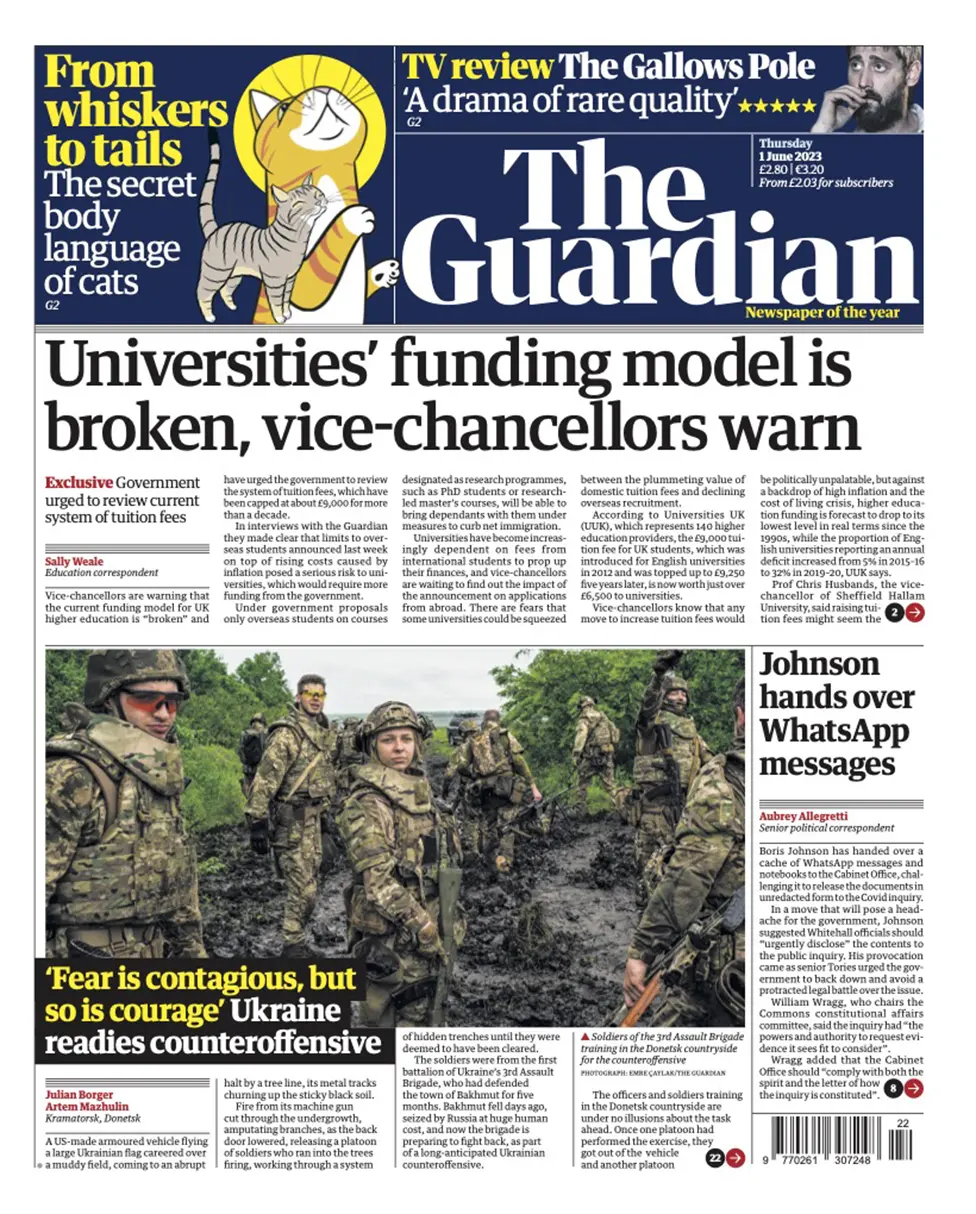
The front page lead in the Guardian (print edition) yesterday morning was headed: “Universities’ funding model is broken, vice chancellors warn”.
Repeated online, and now picked up by The Times, this is the second very public attempt in the national media by the university system to recover from the ban on foreign students bringing family members to Britain while they are studying.
One might have thought that the relatively modest change announced by Suella Braverman earlier this week could easily be absorbed by a higher education sector which grosses over £40 billion a year, employing around 230,000 academic and 220,000 non-academic staff, handling over two million students of which nearly 80 percent are undergraduates.
But, as the Times Higher Education Supplement explains, the ban will be intensely worrying to a university sector that has become addicted to growth for its sustainability. If, as looks likely, the paper says, the move results in a significant downturn in international student numbers, that could put some institutions in serious trouble.
Between complex accounting treatments, political misdirection and major changes to how the sector is funded, writer James Brackley suggests in a report for the Centre for Research into Accounting and Finance in Context (CRAFiC), the sector is structurally reliant on debt, precarious employment and expanding international student cohorts to cross-subsidise other courses, in order to remain viable.
With concerns about the quality of education, physical lecture space and staff workloads limiting the expansion of high-margin courses, on top of rising interest rates and inflationary pressures, he anticipates that departments, disciplines and possibly entire institutions will face financial difficulty.
However, under current market conditions, his research team finds that the only answer available to the sector appears to be an increasingly unsustainable pursuit of growth – and Braverman seems to have dropped a hand grenade right in its midst.
Since the trebling of tuition fees in 2012, Brackley says, English universities have both expanded their home/EU fee income and, from the mid-2010s, focused heavily on international student recruitment. By 2022, there were more than 100,000 more UK-domiciled students and over 250,000 more non-UK-domiciled students studying in the UK than in 2010-11.
And the UK has already well exceeded the International Education Strategy’s target, set in 2019, of hosting 600,000 international students by 2030; the 2022 figure was 679,945.
As he sees it though, strong financial health at the aggregate level, driven by bums on seats, has always concealed considerable variation by provider as very different institutions grapple with the challenges of mass education.
His team analysed 175 institutions and, of these, 20 reported deficits in at least three out of the past four years after adjusting for non-cash pension movements, and five reported deficits in every single year.
These, he says, were typically non-Russell Group pre-92 institutions, with high overheads and a reluctance to transition to a business model of cross-subsidisation from more generic high-margin, high-volume course provision. Several such institutions have recently announced redundancies.
Many others reacted to the spectre of financial collapse during the pandemic by restraining staff costs, capitalising on insecure employment conditions and the imposition of a zero percent pay settlement, as well as dropping student entry requirements.
However, as high interest rates and inflation raise fixed costs and home fees remain capped, institutions must once again look to student number growth, further increased workloads and, potentially, closures of lower-margin courses.
And herein lies the rub. Brackley tells us that, after a decade of marketisation, UK universities now hold an astonishing £16 billion in external debt on their balance sheets, a figure that had risen by 60 percent in the six years to 2021, before dropping back slightly in 2022.
Servicing that debt also demands expansion, he adds, but even without the government’s crackdown on dependants, there is a risk of the international student market saturating as UK institutions slip down international league tables and other countries, such as Australia and the US, improve their offers, while Brexit continues to affect the number of EU students studying in the UK.
Fortunately for them, major institutional financial crises have affected only a minority of UK universities. But this is not a healthy or sustainable position as it stems from unprecedented sector-wide surpluses generated through the pandemic.
Brackley now thinks that a large number of providers could quickly slide into the red should universities seek to tackle the falling real earnings of their staff, should the international market saturate, or should the strain on space, quality and staff start to deflate the higher education bubble.
That is an interesting turn of phrase – the reference to the “higher education bubble”. As the higher education market “experiment” continues, Brackley says we need to urgently ask whether the business model it incentivises is what we want for universities. And, he concludes, we must consider what to do when the bubble bursts for those that fail to adapt.
From this, it would appear that the reliance on international students is by no means the only problem, but it is a serious one with structural implications for the sector.
Some of this comes over in the Guardian piece. Universities, it says, have become increasingly dependent on fees from international students to prop up their finances and vice-chancellors are waiting to find out the impact of the announcement on applications from abroad.
There are fears, it says, that some universities could find themselves squeezed between the plummeting value of domestic tuition fees and declining overseas recruitment.
Thus we have Prof Chris Husbands, vice-chancellor of Sheffield Hallam University, calling for a change in the way universities are funded. He sees the solution as a hybrid public-private model, possibly based on a teaching grant for higher-cost subjects, underpinned by loans which could be set at the cost of teaching lower-cost subjects, plus a maintenance offer for poor students.
Prof Charlie Jeffery, vice-chancellor of York agrees the system is broken, noting that most universities are now losing money on teaching home students. “That’s a difficult place to be at the best of times, and it does require us to think of the other income streams that can help us achieve all of our objectives”, he says, adding: “By far the most significant one of those is international students”.
Jeffery is therefore concerned about “changes in policy which might undermine the UK’s attractiveness to international students”, with one of his colleagues fearing we will continue to see deterioration in the sustainability of institutions, rendering them less attractive to international students, making it even harder for the sector to make ends meet.
Looking at this in the round, together with previous work, a disturbing picture is beginning to emerge.
From 1999 onwards, beginning with Tony Blair and his Prime Minister’s Initiative (PMI), successive governments have set about attracting international students, the fees from whom could be used to support an otherwise unsustainable university funding model.
But it was not the academic excellence to which international students were attracted, especially as there is good evidence that the expansion of the university system has brought with it a measurable drop in standards, with concerns continuing to this day.
By 2006, when the second phase of Blair’s PMI was launched, it was being officially acknowledged that “employability” had become a significant element of the deal, a concept carried over into the 2013 Global Strategy under the Cameron coalition administration, and then strengthened by the 2019 International Education Strategy devised by the May administration.
A UK higher education was presented as “an entry ticket to the best paid employment and a preparation for a globalised world of work”, with international students choosing to study in the UK to gain an advantage in the labour market through a British qualification, as a “return on investment”.
As I have then remarked the access to the UK employment market conferred residential privileges which, in time, permitted former students to apply for British citizenship.
In effect, British governments have been leveraging employment and citizenship as an inducement to foreign students to pay for a university system to which they were unwilling to commit sufficient funds.
The inevitable consequence of this – now that chickens have come home to roost – is an unsustainable uptick in non-EU immigrant numbers, which has forced the government’s hand on foreign students’ dependents.
With an increase in home student tuition fees presenting an unacceptable political risk, especially in the run-up to an election, the funding model is now poised to crash to a halt. And yet, Sunak’s administration has no answers other than to keep pushing the “international student” button – which Braverman has disconnected – and keeping us focused on illegal immigration.