Politics: end of the line
By Richard North - March 22, 2023

I didn’t actually want to write about Johnson. Despite his prominence in the media at the moment, there isn’t a lot to say. Marina Hyde nails it.
When Boris Johnson “flops himself out in front of the privileges committee” she writes, he will ask it “to consider an auto-satirical question: did the foremost British liar of the age tell a lie?”.
After a little rhetorical meander, including an observation that £220,000 and rising has been spent by the taxpayer on Johnson’s legal defence, Hyde concludes, “Lol of course he told a lie – it’s BORIS JOHNSON?!?!?!?!?”.
Nevertheless, on the basis of his 52-page submission – the best that £200,000 of taxpayers’ money can buy – he may be able to bullshit his way through the committee hearing. Asserting that he did mislead MPs, but not “intentionally”, may even be enough to muddy the waters.
But even if he doesn’t manage to convince the seven committee members of his innocence, he may do just enough to ward off a vote by the whole House and avoid being suspended from the Commons, retaining his seat until the next election.
In a sense, though, it doesn’t really matter. Today will be the last shout of yesterday’s man – something on which numerous commentators agree. Whatever the outcome, the Johnson spell is broken. He will never again hold sufficient sway to get close to power.
This becomes apparent, not just from the Guardian, where he is universally loathed. Just about everybody is kicking the man while he’s down, witness the piece in The Times by Daniel Finkelstein, who writes under the heading: “It’s the hypocrisy that will do for Boris Johnson”.
This columnist leads with an exploration of the nature of lying, citing author Bella DePaulo who has written extensively on the psychology of lies. DePaulo, Finkelstein tells us, always stresses the role that the lied-to have in enabling lies. A consistent theme of hers is that some people want to believe liars so badly they will go to great lengths to stick with them even as the deception unravels.
So it is with Johnson. He will have some friends whatever he says to the privileges committee, and he will have some friends whatever the committee decides. These friends will accuse the committee of bias and his critics of mounting a coup. Because for some people Johnson is too good to be true and they want him too bad.
Finkelstein’s next observations are hardly contentious either. He thinks that the number of these friends is diminishing and is no longer enough to carry the day. There will be relatively few people who find his defence convincing. If the committee finds against him, most people will side with the committee. And if they propose a heavy sanction, most will support it.
The reason for this, he advances – drawing on a book about political hypocrisy by David Runciman – is that, whatever voters may think about lying, they hate hypocrisy.
Johnson, Finkelstein says, is no longer the laughing cavalier, breaking rules that everyone else hates, winking as he transgresses. He is the person that created the rules and then broke them. The rest of us were doing what he told us, and he wasn’t doing what he told us. And when facing this new, much more dangerous, charge – hypocrisy – he finds himself unable just to barrel on.
Thus, with our money, he’s had to buy in a KC and start appealing to voters and his parliamentary colleagues to believe, despite his history, that the words he spoke in the Commons were used with great care and a passion to get to the truth. In so doing, he has become the standard evasive politician talking about the difference between rules and guidance, between reckless and deliberate.
Previously, Johnson has dazzled and amazed, concludes this columnist. But now he is a magician whose trick won’t work anymore. The spell has been broken. Hypocrisy has broken it.
However, it may not be just hypocrisy which does for Johnson. Finkelstein’s paper, on its front page, runs a story headed: “Aide warned Boris Johnson about Covid claim”, contradicting the ex-prime minister’s claim to the Commons that coronavirus guidance had been followed in Downing Street “at all times”.
The ”aide” is Martin Reynolds, Johnson’s principal private secretary when he was prime minister. And he advised his then prime minister, back in December 2021, that he should remove a claim from his opening statement that “all guidance had been followed at all times”.
And yet, while Johnson deleted the line, he went on to tell the Commons less than half an hour later that “the guidance was followed, and the rules were followed at all times”. And this is what got him into trouble.
Johnson also appeared in the Commons on 8 December 2021 for PMQs, after the release of a video that showed staff joking about parties during lockdown. Reynolds has told the privilege committee he said that on that day he had “questioned whether it was realistic to argue that all guidance had been followed at all times”.
All Johnson can manage by way of an argument is that, while some of the statements made to MPs proved to be inaccurate, he believed them at the time to be true.
For all that, though, what really must finish off the Oaf is the Telegraph where, for so many years he has been the paper’s favourite son – but for no longer. It has chosen Suzanne Moore to do a hatchet job, the like of which it would never have published when he was on the ascendance.
Almost in the nature of heresy, the headline reads: “As usual, Boris Johnson believes he’s above the law”, with a sub-heading, “The utter self-belief that propelled him to power is now revealed as monstrous arrogance, and his clowning looks cheap and disrespectful”.
Whether Moore may or may not have had issues with Johnson, the appearance of this article signals the end of the paper’s love affair with this serial liar. The public has made up its mind, she writes. Especially those whose loved ones died alone and whose funerals were small bleak affairs as they stuck to the rules.
Furthermore, she says, a lot of the Tory party have too; there is no way back for him but he refuses to hear that. There are those who still think he is charmed, that lockdown was unnecessary, that his rule-breaking is less important than his ability to win elections.
But, she adds, the veil has lifted, that unpredictable moment has happened when a joke is no longer funny, when an actor loses the audience, when the old lies no longer work. Power has drained away from him and that was obvious on his mad dash back in the leadership contest.
Any hope of a reinvention for Johnson is wishful thinking, and to see him kicking and screaming about being made accountable is a revolting spectacle. It serves, Moore concludes, to remind us of why he should never have been in power, not why he should be again. The kindest thing to say is that he believes his own lies. Thank god, she says, the rest of us no longer have to.
Then, putting the boot in, Camilla Tominey writes her own piece, asserting that Johnson does not need to be found guilty of deliberately lying to the Commons for the truth of his premiership to be exposed.
Referring to his dodgy dossier, she observes that, while he may be across the detail now – three years on from the first lockdown – what his 15,256-word account shows is how little grasp of the detail he had when he was laying down the law.
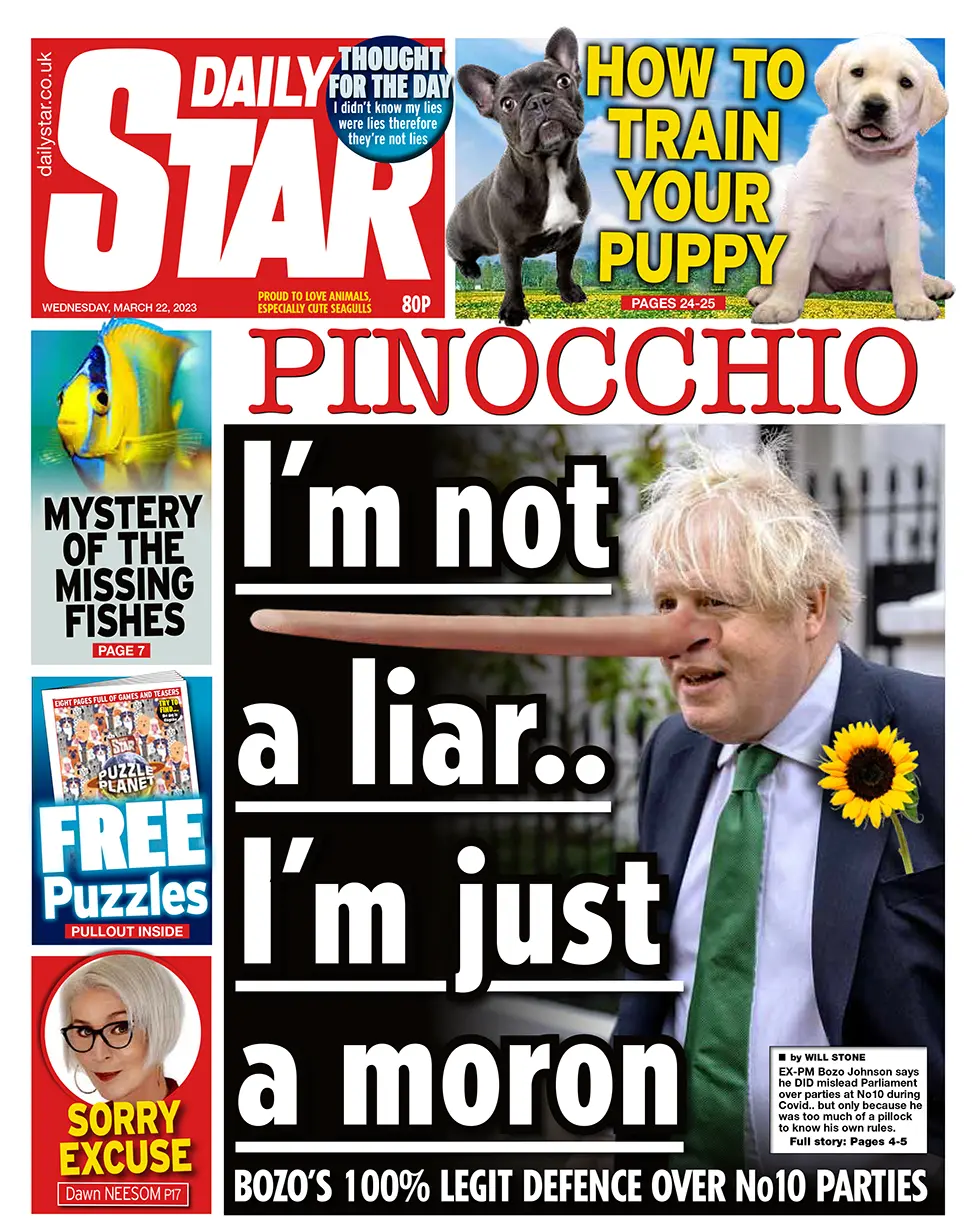
Yet it is the Daily Star which should, perhaps, have the last word. Its front page (pictured) reads: “I’m not a liar… I’m just a moron”. He did mislead parliament, the story goes, “but only because he was too much of a pillock to know his own rules”.
Either way, he’s doomed.