Ukraine: squelch, bloody squelch
By Richard North - February 23, 2022

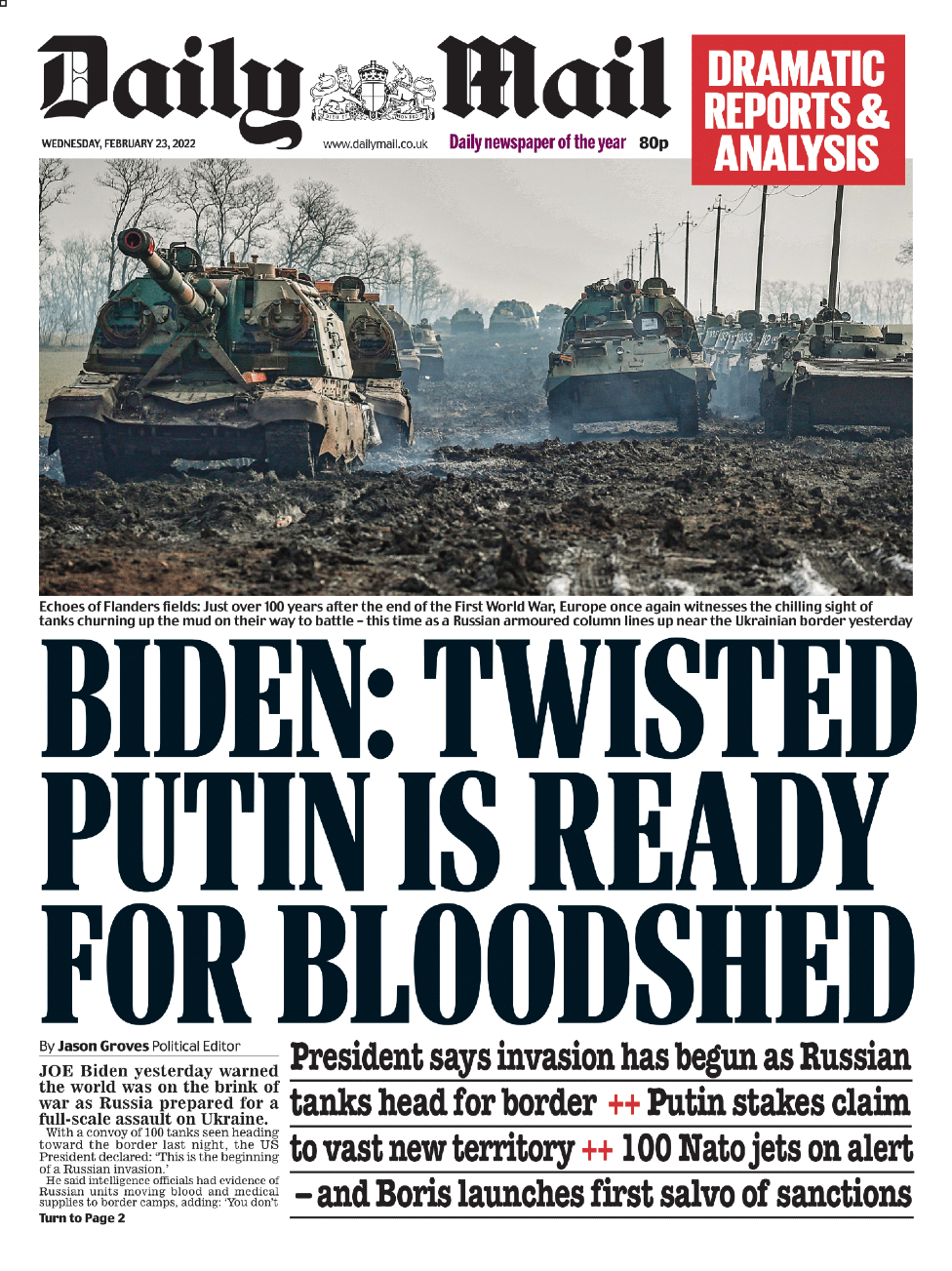
A number of papers use photographs of the Russian 2S19 Msta self-propelled howitzers, as illustrated above, the Mail on its front page going so far as to refer to the “Echoes of Flanders fields”.
The paper just can’t help itself in describing how Europe is once again witnessing the “chilling sight of tanks churning up the mud on their way to battle” – with not a single tank in sight on what was described by the Telegraph as a road in Rostov – opposite the south-east corner of Ukraine.
The Mstas, incidentally, may be these (pictured in the article) seen close by at Taganrog. From the look of the pristine condition of the paint on the muzzle brakes, they haven’t been fired recently.
This apart, what the Mail misses, of course – as do the other papers who use the photograph (or variations of it) – is the impact of these conditions on any potential invasion, forgetting that it was a certain president of the United States who recently said that Putin would “have to wait a little bit until the ground is frozen” before he could invade Ukraine.
Yesterday for the area, one weather report had the temperature as 4ºC, with light rain. And that was all it took for heavy tracked vehicle to churn up the ground – manageable for these vehicles but a nightmare for the wheeled supply trucks that must follow. Johnson’s “lighting” war has become a distant fantasy, bogged down in glutinous mud.
Thus, when we get Nato secretary general Jens Stoltenberg, who opined yesterday that there is “every indication” that Russia is continuing to plan for a full scale attack on Ukraine, one has to wonder whether he is truly on this planet.
Nevertheless, the man asserted: “We see the ongoing military build-up”, adding, “They promised to step back but they had continued to step up. We see that more and more of the forces are moving out of the camps and are in combat formations and ready to strike”.
This was very much the narrative on Monday, with a spokesman for Johnson telling the media that “the intelligence we are seeing suggests that Russia intends to launch an invasion and that President Putin’s plan has already begun”. “We’re seeing elements of the Russian playbook that we would expect to see in certain situations, starting to play out in real time”, he added.
This was bolstered by breathless reports in the Mail and elsewhere, publishing social media videos. Particularly ominous were the tanks and other equipment lined up on the roadsides close to the Ukrainian border, in the Maslova Pristan area, just north of the Ukrainian border city of Kharkiv, all pointing to the imminence of the invasion.
We learned later, though – through the New York Times (but seemingly unrecorded in any UK media organ) that Russian deputy defence minister, Nikolai Pankov, had accused the Ukrainians of massing 60,000 troops on the borders of Donbass. Ready to attack the separatist enclaves.
Although the Ukrainians have emphatically denied having any attack plans, this might explain the Russian action. As I remarked at the time, a Russian attack at this point didn’t make sense, leading me to suggest that the presence of the forces on the border were a feint, intended to draw Ukrainian forces away from Donbass, and prevent them intervening.
That, in the light of Pankov’s comments, seems to be a plausible explanation – pre-emptive action by the Russians to prevent what they saw was an imminent Ukrainian attack. And yet, Biden – from his press conference yesterday afternoon – sees the action as “the beginning of a Russian invasion of Ukraine”.
Biden has it that, “Putin authorised Russian forces to deploy into the region – these regions”, and he asserts “that these regions are – actually extend deeper than the two areas he recognized, claiming large areas currently under the jurisdiction of the Ukraine government”. In the American president’s view, therefore, he was “setting up a rationale to take more territory by force”.
The Russians, on the other hand, are denying any intention to send in troops “for now”. Deputy Foreign Minister Andrei Rudenko told the AFP news agency that the friendship treaties signed by the Donbass leaders included the provision of “military aid” but added that “speculation” on troop deployments should be avoided.
“For now”, he said, “no one is planning to send anything anywhere. If there is a threat, then we will provide assistance in accordance with the ratified treaties”. It was then left to Putin, to agree that he did recognise the full extent of the Donbass claims. Specifically, he said:
With regard to the borders within which we will recognise these republics, we did recognise them, which means we recognised their foundational documents, including the Constitution, and the Constitution stipulates their borders within the Donetsk and Lugansk regions at the time when they were part of Ukraine.
However, he then went on to emphasise that all disputes would be be resolved “during talks between the current Kiev authorities and the leaders of these republics”. Unfortunately, he said, “we realise that it is impossible to do so, since hostilities are still ongoing and, moreover, they are showing signs of escalating. But I hope this is how it will turn out in the future”.
Having been authorised by his parliament, in what amounted to a rubber stamp decision, to use his armed forces abroad, Putin noted that the treaties with the Donetsk People’s Republic and the Lugansk People’s Republic contained “relevant clauses that say that we will provide these republics with appropriate assistance, including military”. Since there is an ongoing conflict there, he said, “we make it clear by this decision that, if need be, we plan to fulfil our obligations”.
This has the Telegraph remarking that Putin is raising the “fear of all-out war”, while the paper is still running speculative pieces suggesting that the Russians are planning to invade Kiev.
And although Stoltenberg asserts that Nato has seen further Russian troops moving into Donbass, into parts of Donetsk and Luhansk, there is no actual evidence that the movements seen were Russian rather than separatist forces. Grainy videos, in poor lighting conditions, show convoys of trucks and MT-LB light armoured personnel carriers, a picture of an ancient T-80 and an equally geriatric T-72 – all without discernible markings.
Both Biden and Johnson however, have initiated sanctions. Given the minimalistic actions by Putin, though, they fall short of Johnson’s claimed “barrage” of sanctions, with further action being reserved in the light of new developments.
The EU has also joined in the fun and games, also standing ready “to adopt additional measures at a later stage if needed in the light of further developments”. With the Germans then suspending the Nord Stream 2 approval process, the European stance is so far retaining a semblance of unity.
Where we now stand depends very much on your point of view. As one might expect, the Telegraph sees the situation in unequivocal terms, as the first step in the dismantling of Ukraine – suggesting that if Putin is allowed to succeed, “he will come back for more, with the Baltic states next on his list”.
Some commentators see this as having parallels with the 1938 dismantling of Czechoslovakia, under pressure from Hitler, with a whiff of Munich-style appeasement in the air. Others might look for their historical parallels to the French occupation of the German Saar from 1944 until 1957 when the region decided to re-join Germany, contrary to French wishes.
In the latter event, one might note that a transfer of power, in accordance with the wishes of the people was managed without bellicose rhetoric and military intervention. Have we now lost the ability to resolve such matters without endless histrionics?