Ukraine: trivial pursuits
By Richard North - June 11, 2023

For someone who has made a virtue of highlighting the plight of Ukraine – even if his primary motivation was self-preservation – it is something of an irony (in a development where ironies abound) that Johnson should be almost single-handedly responsible for driving news of the counter-offensive off the front pages of the British media.
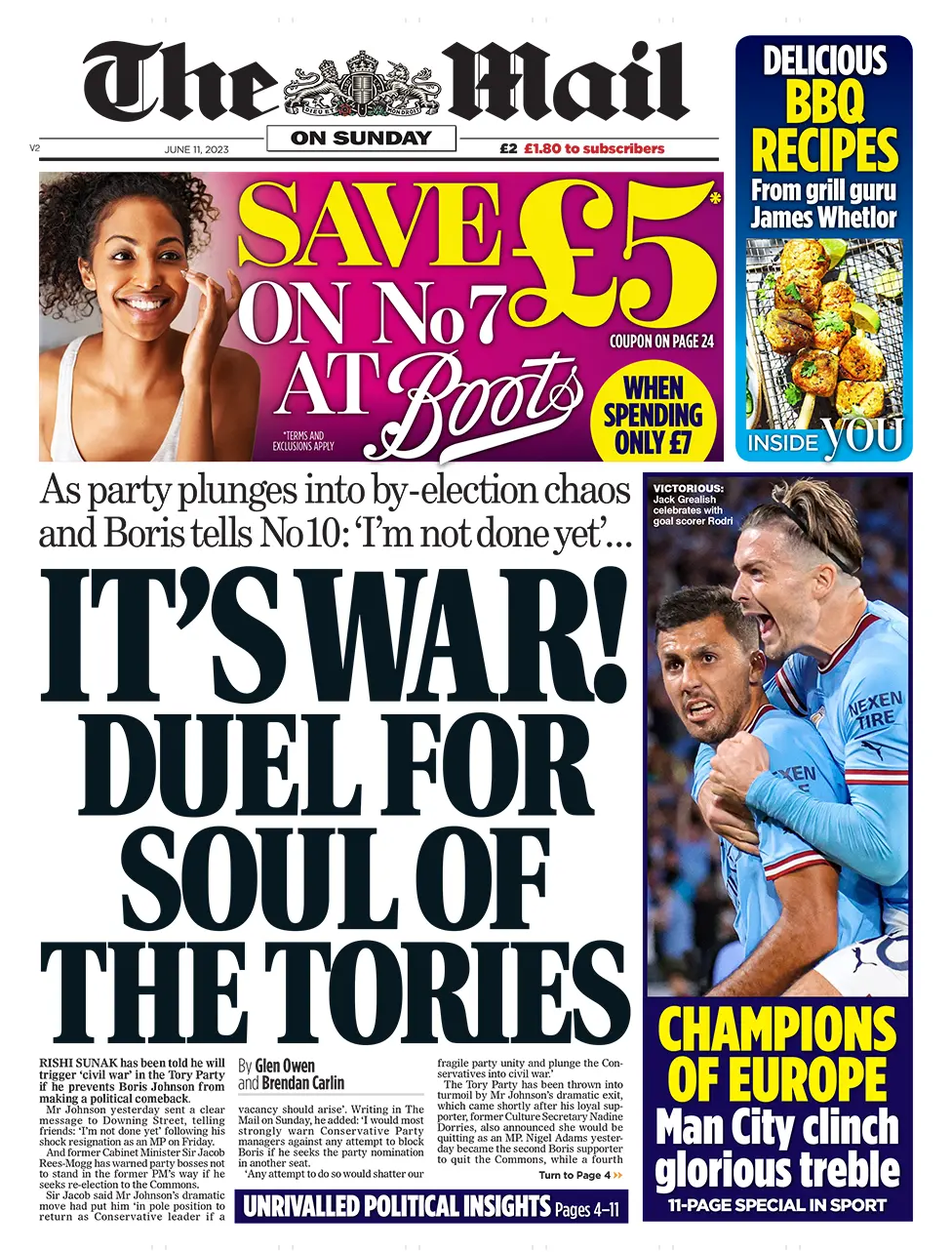
Eschewing reports of the real war, two titles are referring to the Johnson drama as “war” on their front pages, the Mail on Sunday displaying a classic loss of perspective, with its banner headline: “It’s War! Duel for soul of Tories”.
To an extent, this drama is rather convenient. Despite Zelensky now giving his clearest indication that the counter-offensive is underway, there is actually very little to report of its progress – even if the president claims that his top military leaders “are all in a positive mood”.
Without more detail, the British papers are able to stay in their comfort zones, reporting on the domestic political soap opera, rather than the complicated and difficult matter of a real shooting war.
As of Friday, the most authoritative comment on which we could rely came from Reuters stating that, “with virtually no independent reporting from the front lines and Kiev maintaining strict silence on its plans, it was impossible to assess whether Ukraine was having success in penetrating Russian defences to drive out occupying forces”.
At that point, the only confirmation that operations were in progress came from the Russian Ministry of Defence, with some internet reports suggesting that Ukrainian forces had taken some losses (pictured).
These were claimed to include a Leopard 2A6 MBT, four M2 Bradleys (three of which were damaged) and a vehicle described as a BMR-2 mine-clearing tank (which may be a BMR-1). And although precise context and details are difficult to get, this is perhaps not the sort of image the Ukrainians would have preferred to illustrate their offensive.
Without waiting for official confirmation (from either side) and before the Johnson swamp had taken over, many newspapers were filing reports and opinion pieces – some more lurid than others, attributing almost magical properties to the 14 Challenger 2s donated by the UK.
The Mail takes a similar “gung ho” view, claiming that there have been “early successes”, with Russia on the backfoot and Western weapons turning the tide. The Independent, quoting the British MoD, says that Ukraine has “penetrated” the first line of Russian defences in some areas and is making “good progress” in its counteroffensive.
A more sanguine note from The Times tells us that hopes were high among Ukrainians that large swathes of territory could be recovered, while noting that the deployment of “precious German-made Leopard 2 tanks” suggests that Ukraine was “serious”, although the outcome is “far from certain”.
The paper cited professor Michael Clarke of King’s College London’s department of war studies, venturing that Ukraine’s army apparently wanted to “take route one” and punch south through occupied Zaporizhzhia to reach the Sea of Azov near Melitopol and Berdyansk.
This would cut off Russia’s land corridor to Crimea, though Clarke concedes that talk of this route could yet prove to be a feint to disguise an attack further east, towards the port of Mariupol. The “route one” scenario, he says, would require taking the heavily defended city of Tokmak, a key Russian supply node, meaning the Ukrainians were “either very confident or very reckless”, Clarke adds.
Bringing their reporting up-to-date, the sister paper – the Sunday Times upstages Clarke, relying on Lawrence Freedman, an emeritus professor of war studies, also at King’s College. In a somewhat ponderous piece, he tells us that it will take time before we have a clear sense of how the battles are unfolding – a quote that must qualify for the “no shit, Sherlock!” remark of the day, but for what follows.
The Ukrainians, the Great Sage opines, will need to learn from early encounters so they can adapt tactically and show the flexibility that will enable them to exploit unexpected openings and shift from areas where Russian resistance is too great.
In particular, he drones, when and if they do break through Russian lines they will need to have available the combat power to exploit any gains – something that was lacking when they were able to send Russian forces into retreat in Kharkiv in September.
What, of course, Freedman doesn’t say is that the “combat power”, needed to create the shock effect and dominate the battlefield, still doesn’t exist. And, if the Ukrainians fritter away their Western equipment in penny packets, they will lose momentum, despite the best efforts of the Russians to cede the ground.
With so little to go on, though, rather predictably, much of the media is still focusing on the Kakhovka dam breach. This is the line taken by the Observer which, in a long piece today, treats the counter-offensive almost as an afterthought.
Conceding that, on the long-awaited counter-offensive, the future of the war, of Ukraine and perhaps even Russia, hinges, it notes the pictures circulating on the first losses of western armour, stressing the daunting task facing the Ukrainians.
For this, it uses Franz-Stefan Gady, a senior fellow at the International Institute for Strategic Studies, citing a comment he made on Twitter. “With the exception of the US, no other western-style military can conduct sustained combined arms operations at scale”, he says, adding: “So Ukrainian forces are attempting to do something at the tactical level that no other European Nato member is currently capable of”.
Despite this, David Petraeus remains bullish, telling the Washington Post that, while he expects the Ukrainians to take “tough casualties”, they are likely “to achieve significant breakthroughs and accomplish much more than most analysts are predicting.
On the other hand, without even having the Johnson soap opera as an excuse to ignore the counter-offensive, the New York Times also combines coverage with the dam breach, devoting most of its attention to the floods.
The sense of frustration, though, is palpable, as it complains that the Ukrainian military is guarding battlefield information closely and has offered only broad acknowledgment of the clashes playing out along the front Friday night into Saturday.
Relying on “military analysts” rather than hard data, we are told that it appears that Ukraine is trying to break through the Russian lines at several locations in the south and east, near the towns of Orikhiv in the Zaporizhzhia region and Velyka Novosilka in the Donetsk region.
We are asked to accept the Ukrainian military claim that, over the past 24 hours, its forces fired rockets and artillery, hitting four Russian command centres, six areas of concentration of personnel, weapons and military equipment, three ammunition depots and five enemy artillery units in firing positions. But, says the NYT, the claims could not be independently verified.
Needless to say, the Russians are claiming that they have beaten back all the Ukrainian attacks, but then they would say that. Putin has even made a “rare comments on battlefield developments”, admitting that fighting had been ongoing for five days, claiming that Ukrainian forces “did not reach their aims in any area of combat”.
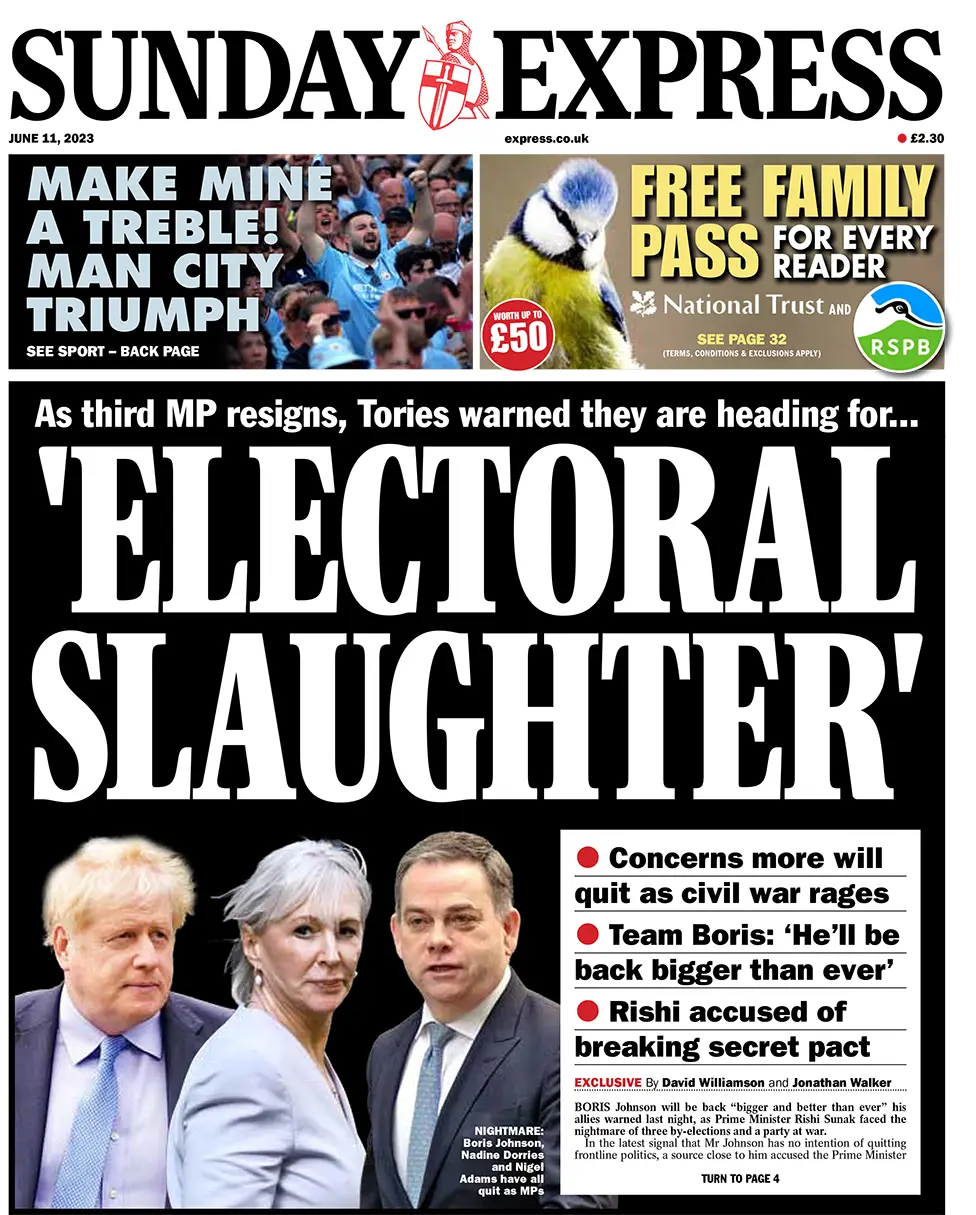
However, such trivial issues are nothing compared to the “civil war” in the Conservative Party, which is preoccupying the British media. With the Sunday Express offering the headline, “Electoral slaughter”, one can immediately appreciate how unimportant news of actual slaughter might be.