
Politics: disorder in the House
By Richard North - June 4, 2026
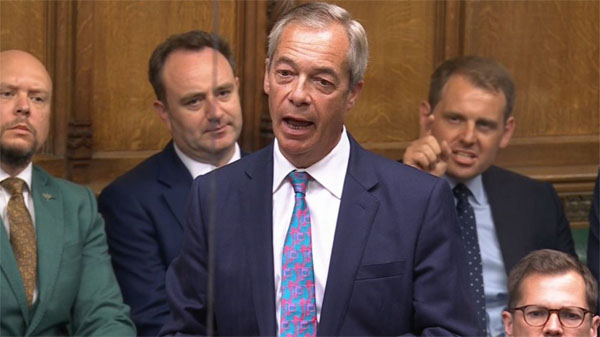
Entirely gratuitously (i.e., unasked) Stamer opened his session in yesterday’s PMQs with a reference to the Nowak controversy.
“Henry Nowak’s family”, he said, “have shown extraordinary dignity after their son’s life was stolen in appalling circumstances. He was clearly a kind, thoughtful and much-loved young man”.
Having laid that as his baseline, he then cautiously conceded that “There are serious questions to answer, including how accusations of racism informed police thinking”. We are, he said, “supporting the Independent Office for Police Conduct to get to the bottom of what happened”.
The punchline quickly followed: “But no matter the pain we feel, there is no justification for more violence and disorder. The attacks directed towards police officers in Southampton last night were disgraceful and completely unacceptable”, he said.
In a sideways dig at Farage, he took it upon himself to declare that: “This is a time for serious work, not rage”, before doing his Judge Dread bit, with a “blood and fire” warning: “Let me be clear”, he said, reading from his notes, “we will ensure that anyone found engaging in disorder meets the full force of the law, as we have done before”.
In a limited and cowardly intervention, the Badenough avoided any controversy, confining herself to a brief repetition of the “deepest condolences” to the family and friends of Henry Nowak.
The circumstances around Henry’s wrongful arrest and tragic murder must be a wake-up call to the entire country and our institutions that every life matters, she said, asserting that “it is the responsibility of everyone in this House to bring people together, not divide them”. Moving on quickly, she then asked Starmer “by how much the welfare bill has risen since he came to office”.
Starmer, however, was quick to express his gratitude for being let off the hook so easily, thanking the leader of the opposition “for her approach and tone in relation to the tragic Henry Nowak case”. The “uniparty” was closing ranks.
Contributing to the closed-shop love-in was the revolting Ed Davey, who declared that “the murder of Henry Nowak was an evil crime made much worse by the lies of the killer and the police response”. The investigation must uncover everything that went wrong, he said, “and all police forces must act on its conclusions”.
But that was just the overture, with Davey’s real message to follow: “Outside court, Henry’s father made a powerful plea that his son’s murder should not be used to create further division but should instead be used to treat knife crime as a national emergency”, he said.
That paved the way for the delivery of a sycophantic, patsy question to Starmer. “Does the Prime Minister agree that the victims of knife crime and their families deserve a politics where we come together to solve these problems, instead of using them as a political football?”, he asked.
Of course the prime minister agreed, thanking “the right hon. Gentleman” for the approach he had taken. “It is important in a case like this, which is so tragic, that we reflect on our leadership roles here as political leaders”, he added.
Sanctimony to the fore, he then proffered a prissy little lecturette, intoning: “It is our duty to bring people together at a time like this, not to seek to divide them. It is particularly our duty to listen to what the devastated family are asking of us as political leaders”.
With that, he thanked all those who had acted in that way, because he thought “that is the right way to respond”, leaving a purring Davey to reciprocate the thanks and “completely agree” with the prime minister. “We stand ready to work with the Government on serious policies to tackle knife crime”, Davey crowed.
Enter the unknown Noah Law, Labour MP for St Austell and Newquay, to trot out the grossly over-used and entirely misplaced cliché, asserting that: “The whole country is united in its horror at the tragic death of Henry Nowak”.
The country is, of course, very far from being united, but the real meat of the question was to give Starmer another patsy. “Will the Prime Minister join me once again in paying tribute to Henry’s family for their courage in the face of this tragedy?”, little Noah gushed. “Will he also join me in calling for recognition of the serious mistakes made by the police, which we must learn from so that no family faces this tragedy again?”.
Starmer was happy to oblige. Taking advantage of the plant, he happily thanked his “hon. Friend” for raising this “really important case”. And out came the extruded verbal material: “My thoughts are with Henry’s family, as are the thoughts of the whole House and the whole country, I am sure”, he oozed.
Not done with that, he turned on the nausea-inducing sincerity machine. “I have watched the bodycam footage, as others will have done, and I found it really hard. It was harrowing. As a dad of a 17-year-old boy, I felt sick. I can only imagine how devastated his family are. It is extremely moving”, he dripped.
“Henry’s life has been stolen”, he pronounced. “His family have responded with incredible and immense dignity and bravery. There clearly are lessons that need to be learned and serious questions that need to be addressed, not least the question of how accusations of racism informed decision making in such cases”.
Starmer, though, must have known what was coming next, because his next step was to pave the way for a riposte, with a quote from Henry’s father, who had said: “We do not want his death to be used to create further division, hatred or tension”.
“They are the words of a grieving father who has lost his son”, Starmer announced triumphantly, adding: “I think those words have resonated with people across the country. We must not allow this tragedy to be hijacked by anyone who seeks to divide us”.
By sheer coincidence, the “hijacker” was next – none other than the absent MP for Clacton, Nigel Farage. “Following the horrendous circumstances of Henry Nowak’s death, I urge the Prime Minister to consider this”, said the Reform leader.
“It is now clear to growing millions in this country that we are living under two-tier policing. The instructions that are given to police officers from police bosses are clear and written down in ink: ‘You must treat different ethnic groups in different ways’”, he said.
Gravely, he informed the prime minister: “Apart from the upset and the anger at the circumstances of Henry’s death, the anger that was seen spilling out in Southampton last night is in danger of getting considerably worse if the public lose trust that they will be treated fairly by the police”.
And then, at last, came the question: “Will the Prime Minister take some action, end this divisive practice of two-tier policing, and make sure that all British citizens are treated the same?”.
Tone-deaf Keir was ready: “I do not believe that there is two-tier policing in this country”, he declared, defying logic and the evidence of a thousand examples and more.
With that established, though, Starmer went into full deflection mode. “I am really shocked that the hon. gentleman pretends to have respect for Henry’s family and then acts in this way”.
After a short interruption from the appropriately-named Mr Brash – Labour MP for Hartlepool – Starmer continued his deflection, telling the House: “The grieving family have asked us not to respond in the way that the leader of Reform has responded. They have lost their son in the most appalling circumstances, and they make a simple plea of us as human beings to please not exploit that. We all need to reflect on the words of Henry’s father”.
My response, Starmer said – and the response of others, to be fair – “has been focused on the lessons to be learned so that we can deliver justice. The hon. Gentleman’s response has been to appeal for rage”.
In full outrage mode, synthetic to the last, he snarled: “That is his response to a father who has lost his son and asked for that not to happen. Exploiting this tragedy to create grievance and division would be wrong in any circumstances, but to do it when the family are expressly saying, ‘Please don’t’, is unforgivable. It shows exactly who he is”.
One of those watching from the press gallery was Tim Stanley, who went on to write the parliamentary sketch for the Telegraph, under the headline: “Even the thick ones in Parliament know the woke experiment has gone horribly wrong”. The sub-head put the boot in, stating: “Starmer spends 30 minutes avoiding Farage’s two-tier policing question over the Henry Nowak murder”.
Wrote Stanley: “If the victim could not breathe, MPs cannot speak, because Westminster is paralysed by fear. They know, even the thick ones, that the woke experiment has gone horribly wrong, that it has broken trust in policing and persuaded millions that the state is biased against them – a recipe for riot, for when people don’t trust democracy, they turn to the streets instead”.
The result, he concluded, was that MPs are now terrified of their own voters, particularly the poor ones, regarding them like a wild animal that has wandered into the enclosure and could turn nasty any moment. So, they step around them with caution, using gentle words in soft whispers: “Please don’t riot, please don’t riot. There, there. Who’s a good boy?”
But, says Stanley, the riot has begun, the rage at Farage is displacement. “It was a desperately sad scene, as if shouting at a youth for playing with matches while, around them, the House was burning down”.
They are the flames of Hell – and the fury of the voters scorned. The gulf between parliament and the public has never been wider.
