
Politics: the Burnham bounce
By Richard North - June 19, 2026
It is not often that the consolation prize is handed out before the main event, but at least the Tories had something to be pleased about, celebrating the fall of Aberdeen South – their first Scottish by-election win in 53 years, wresting the seat from the SNP.
It was not only was a win though, it was an absolute wipe-out with the Tories rising from the third place they had managed in the 2024 election, champing at the heels of Labour with 11,300 votes compared with 11,455, both chasing the SNP’s 15,213 votes on a 60 percent turnout.
Now, with the turnout sitting at a miserable 31.36 percent, compared with 59.9 percent in 2024, the Tories soared to 14,308 votes as Labour’s Nurul Hoque Ali suffered a devastating collapse to produce a mere 1,550 votes, while the SNP crossed the line with 8,258 votes – almost cut by half.
In this contest, Reform was not a serious contender but, for the record, its vote dropped from 3,199 in 2024 to a mere 2,478 votes. The city – home of the last typhoid outbreak on the British mainland had not succumbed to this new form of political infection.
By then – well past 2am – the second Scottish by-election at Arbroath and Broughty Ferry was also in the bag – this one a win for the SNP with a much reduced vote of 9,802, again nearly halved from the 2024 result when the party’s Stephen Gethins had turned in 15,581 votes.
Once again, the Labour vote collapsed, down from 14,722 in 2024, to a miserable 3,651, coming in behind Reform which saw a modest uptick, from 3,800 votes in 2024 to 4,341 in this current contest. The Tories here also saw a decline, from 6,841 to 4,542, so there is no Conservative renaissance in the making.
All this, of course, was but the curtain-raiser to the event of the night, the mighty contest in Makerfield, where the suburbs of Wigan had, apparently tunned out in force to anoint a new MP.
As the polls closed, Reform – one half of a two-horse race – was saying that the result was too close to call. On the other hand, from the Burnham camp – sometimes described as Labour (except on the election literature) – there was “cautious optimism”.
As the night wore on, the optimism grew less cautious by the hour until, around 3am with the result imminent – mercifully earlier than the 5am as the latest prediction for the result – Burnham’s supporters were talking of their man having secured 54 percent of the vote.
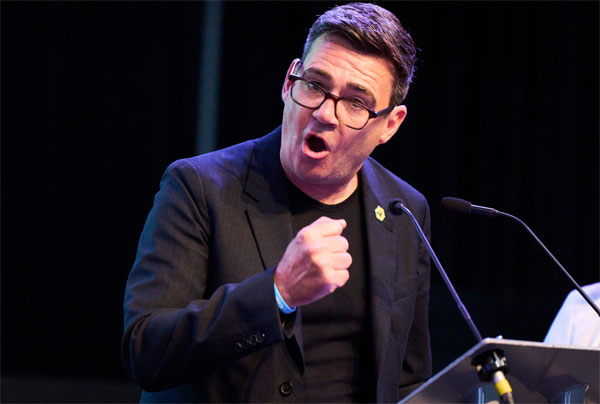
When the result came, the claim turned out to be spot on. Andy Burnham walked away with 54.8 percent of the vote, pulling in a stupendous 24,927 votes – outstripping his predecessor and political benefactor, Josh Simons, who only gained 18,202 votes in the 2024 general election (45.2 percent of the vote).
For Burnham, this is a dream result. It’s a clear vote of confidence in an election that has delivered a turnout of 58.75 percent (notionally 59 percent) in a traditionally low-turnout constituency which only managed 52.5 percent in 2024.
Altogether, it is a remarkable performance. This is the first increased turnout at a by-election compared with a general election since the 1982 Glasgow Hillhead by-election over 40 years ago. A turnout surge of this magnitude (greater than 6 percent) has not been achieved since the 1958 Torrington by-election.
For Reform UK, though, the result is a disaster. Claimed at the outset to be “too close to call”, it isn’t even close. Their lacklustre candidate, Robert Kenyon is almost ten thousand votes behind, trailing with 15,695 on a share of the vote of 34.49 percent.
Other losers are the constituency polls, not of which get anywhere near predicting the size of the gap between Burnham and Reform, although the Opinium poll got pretty close on the Restore vote, forecasting 6.6 percent as against the 6.84 percent actually delivered, with 3,111 votes.
This keeps Restore in the game which, even though barely possible, managed to field a candidate even worse that Robert Kenyon – the hopeless Rebecca Shepherd, so bad that her handlers had to keep her away from the hustings and stop her opening her mouth in public.
With her indifferent voting performance, Shepherd even deprived Reform of the alibi of a “split vote” to explain its failure to win the seat. Split, the vote on the right certainly was, but not enough to make a difference. Even without the Tories (997 votes, on a 2.19 percent share, for probably the best candidate in the line-up) Reform managed to fail all on its own.
The fact that Burnham secured 6,100 more votes than both Reform and Restore combined will hugely burnish his credentials for No 10 among Labour MPs and members, says the Guardian.
In a way, though, this by-election was an unfair test which, in all probability, no Reform candidate could have fully met. Clearly, Makerfield voters wanted someone who could oust “two-tier” Keir. Thus, as Pete observes, the results say more about Starmer’s popularity than they do the standing of the candidates.
But now, as Reform fades into the background to lick its wounds, and Restore polishes up its neo-Nazi credentials, we have the soap opera of a Labour leadership contest to distract us.
In the interim, Burnham says voters had told him they felt “neglected” and that “the country works for other people and other places but not for here”. “That changes tonight”, he declared. “This result changes that. This result will bring about a country that works fairly for everyone. People here have voted for change, they have voted for more power for the north and everywhere forgotten by Westminster. Now let’s give that back to them”.
With that, Makerfield may get what it wanted, but the rest of us weren’t asked, and whether Burnham wins or loses the next round of his quest to become The Great Leader, I suspect none of us will get what we really want – or deserve.
