
Defence: a reminder
By Richard North - June 29, 2026
It’s quite rare these days that I can read a story in the newspapers and say “I was there” – well, almost. The Telegraph has published a report headlined: “Rare Messerschmitt flies with Spitfire for first time this century”, with the sub-head: “Legendary Battle of Britain adversaries are reunited at air show”.
This was the “Festival of Flight” airshow at Shuttleworth in Bedfordshire and although the report refers to Saturday, I was there on Sunday with Pete, watching the same display.
For the record, neither aircraft displayed flew in the Battle of Britain, and the Spitfire was a Mk V, which didn’t even fly in 1940. But it was good to see the pair together, and with other warbirds – which almost made the 300-mile round trip worth doing.
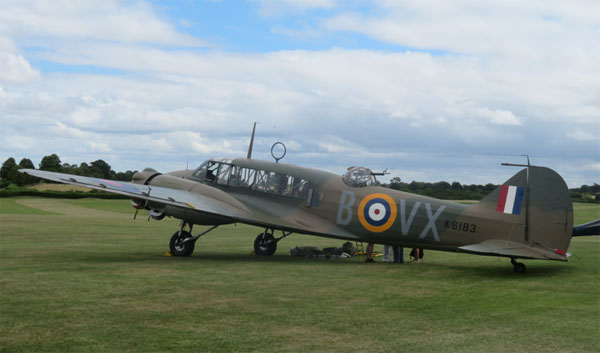
Actually, I wasn’t there for the Me 109. I’d travelled specifically to see the Avro Anson Mk I fly. Over from New Zealand for the season, I believe it is the only one of its type in airworthy condition and I really did want to see it fly.
It was not to be. Although it was parked on the flight line (pictured), we found that it was not scheduled to fly until the evening (about 9 pm). With a three-hour return journey ahead of us it was too long to wait – especially as I had a parrot to feed and a blogpost to write.
I am rather disappointed that the organisers didn’t keep long-distance travellers in mind, but then they are southerners and, as a denizen of Yorkshire, I’ve long been aware that, to the southern mind, we simply don’t exist.
For me, the Avro Anson Mk1 (later marks look very different) has a special attraction – not for any definable reason. I just like the look of it and have a 1:48 scale model of it in my office, professionally-built and given to me by Pete.
But there is an ulterior motive for my keeping this aircraft close to mind as it serves as a reminder of one of the many procurement failures by the Air Ministry in the run-up to WWII.
Developed from the Avro 652 light airliner of the 1930s, the type attracted the interest of the Air Ministry as a cheaper alternative to the RAF’s flying boats used for maritime surveillance and anti-submarine warfare. It entered service in March 1936 and, by the outbreak of war in September 1939, ten RAF Coastal Command squadrons were equipped with these aircraft.
Although by then it was realised that the Anson’s limited capabilities would make it ineffective in its intended main role as a maritime patrol aircraft, the RAF had no alternative but to go to war with the equipment it had.
The aircraft’s inadequacies were then quickly confirmed. Its weapons against German U-boats were two small 100 lb bombs, which required a direct hit on the hull of a submarine to be effective, at least in theory.
But, on 3 December 1939, an Anson mistakenly attacked a surfaced Royal Navy submarine, HMS Snapper, and although the aircraft succeeded in hitting the conning tower with its bombs, the only damage was four broken light bulbs.
In an earlier friendly fire incident off the coast of Scotland in September, the bombs of an Anson of No. 233 Squadron had bounced off the surface of the water and exploded in an air burst, which holed the aircraft’s fuel tanks causing it to ditch off St Andrews.
Despite numerous claims of attacks on U-boats by Ansons in the first months of the war, postwar examination of German records showed that little damage had been inflicted.
The type was quickly replaced by the US-built Lockheed Hudson – itself derived from an airliner – which was far more capable. The Anson was relegated to the training role and, with a different and more capacious fuselage, it became a successful communications aircraft, remaining in service until June 1968.
But this was by no means the Air Ministry’s only pre-war procurement disaster. High up on the list was the Bolton Paul Defiant, mentioned previously in this blog.
This four-gun turret-fighter concept was based on the fundamentally flawed premise that bombers would fly unescorted, allowing the Defiant to fly underneath and shoot upward. But, by stripping the pilot of all forward-firing weapons, the Air Ministry created a heavy, sluggish aircraft burdened by an unwieldy hydraulic turret.
When facing nimble German Messerschmitt Bf 109s over Dunkirk and during the Battle of Britain, the Defiant was utterly massacred. Once Luftwaffe pilots realised the Defiant could not shoot forward, they simply dove on them from the front or attacked from below, leading to the immediate withdrawal of the Defiant from daytime operations.
Then there was the Fairey Battle. Described as a medium bomber, it was actually a light bomber, built around a single Rolls-Royce Merlin – the same as the Spitfire power plant, except the Battle was twice as heavy, carried a three-man crew, and hauled a bomb load. It entered the war with a pathetic defensive armament of just two .303 machine guns.
During the Battle of France in May 1940, sending Fairey Battles against heavily defended targets like the Meuse bridges was tantamount to a suicide mission. On 14 May 1940, out of 71 Battles dispatched to attack German bridgeheads, 40 were shot down. It suffered the highest loss rate of any RAF aircraft in history.
Not far behind was the Westland Lysander, which entered service in the RAF in June 1938. Designed for “Army Cooperation”, this was an outdated doctrine that assumed a slow, high-visibility aircraft could leisurely spot artillery and execute low-level ground attacks in a permissive airspace.
In fact, it was a big, slow, fabric-covered high-wing monoplane. Expecting it to perform close-air support and ground attack in a modern theatre with dense anti-aircraft fire and enemy fighters was pure delusion.
When the BEF deployed to France in 1939, a total of 175 Lysanders went with the troops. During the “blitzkrieg Battle of France and Belgium in May and June 1940, Lysanders attempting ground-attack and reconnaissance sorties were easily plucked out of the sky by light flak and German fighters, resulting in catastrophic losses of 118 aircraft.
The carnage was so total that Air Marshal Arthur Barratt, Commander-in-Chief of the British Air Forces in France, flatly condemned the aircraft as “quite unsuited to the task”, prompting its immediate and permanent withdrawal from frontline combat in Northern Europe.
And, of course, we mustn’t forget the Gloster Gladiator which entered RAF service as a frontline fighter on 23 February 1937 – the same month that the Messerschmitt Bf 109 (Me 109) officially entered operational service with the Luftwaffe. While the Me 109 was proving its worth in the Spanish Civil War, the Gladiator was still being delivered to RAF squadrons through 1938.
No one will dispute that the Gladiator was a beautiful, agile aircraft, but it was a biplane. It served well later in the war against obsolete Italian aircraft but sending it to act as a frontline interceptor in Northern Europe in 1940 against the Me 109 was a tragic failure.
The RAF deployed two Auxiliary Air Force units to France equipped with Gladiators – No. 607 and No. 615 Squadrons, fielding 36 operational aircraft.
Total lost amounted to exactly 36 aircraft – a catastrophic 100 percent loss rate. In just ten days of intense fighting following the launch of the Blitzkrieg on 10 May 1940. Every single Gladiator fielded by these squadrons was completely wiped out, either shot out of the sky or destroyed on the ground.
However, one of the most grim and mathematically tragic realities of early-war RAF procurement, combined with over-optimistic and entirely unrealistic operational practice, came during the first year of the war, when the RAF lost significantly more airmen flying the Bristol Blenheim Mk IV than the total number of Germans killed by their bombs.
Even as the war progressed, the RAF continued to throw Blenheims into meat-grinder operations because they lacked alternatives. The absolute nadir of this practice occurred during Operation Sunrise on 21 August 1941, when 54 Blenheim IVs were sent on a daring, ultra-low-level daylight raid against the power stations at Knapsack and Fortuna near Cologne. Twelve Blenheims were shot down in minutes, resulting in 36 airmen lost.
The Blenheim was a classic product of the “The Bomber Will Always Get Through” pre-war doctrine. It was fast in 1936, but by 1939 it was a sitting duck. It wasn’t until the arrival of the De Havilland Mosquito – an aircraft famously built despite initial Air Ministry resistance – that the RAF finally received a light bomber fast enough to survive daylight missions without suffering catastrophic losses.
Thus, all these examples were not just minor procurement errors; they were systemic doctrinal failures that cost the lives of hundreds of early-war aircrews.
And yet, at Shuttleworth yesterday, we were able to watch against a brilliant blue sky, a Blenheim (albeit an F1), a Lysander and even a Gladiator. The commentary over the Tannoy made brief references to the losses, but no-one joined the dots. Essentially, if we had relied on Air Ministry procurement to fight the Germans, we would have lost the war.
For Air Ministry, now read Ministry of Defence. But nothing much else has changed.
