Immigration: another flood
By Richard North - June 27, 2026
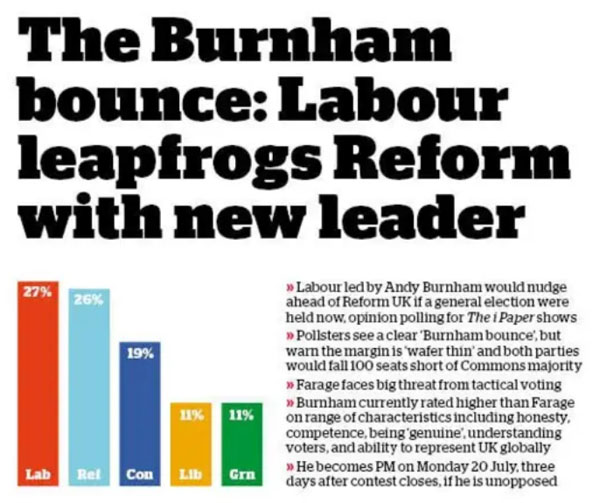
Given that The Replacement has yet to announce any substantive policies, it seems rather odd that the iPaper is reporting on polling that shows that he would leapfrog Reform UK if a general election were held now.
The margin is only slender though: Labour with Burnham as leader delivers 27 percent as opposed to Reform on 26 percent. Although just pipped to the post, on this showing, neither party has enough seats to form a government, each falling short of a majority by a hundred or so seats.
More worryingly, Burnham creeps over the line despite a long-standing reputation for being soft of immigration, a stance which is already casting a shadow over future policy.
This is borne out by the Mail front page which tells us that “a major immigration crackdown is to be softened amid a chaotic scramble by ministers trying to impress Andy Burnham”.
Apparently, the Home Office is preparing plans to exempt care workers from the new rules on ILR, which would otherwise extend their qualifying period from five to ten years – opening the gate to thousands of migrants and their families.
This comes alongside a separate report in the Guardian which has home secretary Mahmood seeking to shore up support for her controversial immigration bill on the progressive left of Labour.
To achieve this, we are told she is planning to speed up the opening of new “safe and legal routes” for refugees, which would have thousands of them transported to the UK without the inconvenience of having to book seats on cross-channel dinghies or hidden spaces in UK-bound HGVs.
What is puzzling here is the apparent disconnect between voting intentions and polling which identifies views on the most important issues facing the country. In the latest YouGov tracker immigration comes second only to concerns about the economy.
The former has a 49 percent listing, as against 49 percent for the latter. Moreover, the trend on the economy is fairly level while concern for immigration is increasing.
Ostensibly, sentiment on specific issues should feed into voting intentions so that an electorate which is demonstrating a high level of concern about immigration might be expected to punish politicians and their parties who are soft on the issue and reward those who prioritise controls.
It is not as if there is any shortage of horror stories to fuel sentiment. Only yesterday, a further tranche of police material was released on the Henry Novak killing, and a sorry tale it told.
Then we have the news of government plans to turn over yet more military bases to housing of illegal immigrants awaiting asylum decisions, including the former RAF base at Linton-on-Ouse in picturesque North Yorkshire.
This is the second time of trying with a similar plan was scrapped in 2022 after public protests and the threat of legal action from the former Hambleton Council.
Now the Home Office is proposing to house almost 4,000 asylum seekers, as the government seeks to move people out of hotels, dwarfing the population of the village which stands at about 1,200.
The evil of this is that the residents of the village, and others in the area, having already fought off one attempt, must now go through the same process all over again. Being the government, they never take “no” for an answer – which is why we hate them so.
The context, of course, in the continued flow of illegal immigrants across the Channel and, as one commentator remarks, in three years we’ve watched the Home Office cycle through containers: hotels, barges, ex barracks, RAF bases.
Each of these is sold as the answer; each ends up in court, in protest, and in headlines about cost, chaos and cruelty. What never changes is the underlying reality: tens of thousands of unresolved cases, limited detention space, weak removal capacity, and ministers treating accommodation as the main battlefield because it’s the bit the cameras can see.
Mahmood’s military bases plan, like the hotel closures it is supposed to complement, doesn’t address that deeper failure; it displaces it – geographically, politically and morally – onto places that “cannot handle that many people”.
Britain, he says, is not a failed state. But a Home Office that keeps rearranging where it warehouses people, instead of fixing why they’re piling up, is acting exactly like a failing one.
If we don’t want military bases full of asylum seekers to be a permanent feature of the landscape, the answer isn’t more bases. It’s a system that stops using them in the first place.
But rather than address that simple truth, we have a government which is prepared to disrupt the lives of thousands of people, while accepting the explosion in crime and the erosion of our high-trust society – all for a cohort of illegal immigrants to whom we owe nothing and from whom we get nothing in return – bar pain and expense.
For those who need an insight into the end game, we see in today’s Mail an account of the deterioration of the northern town of Rochdale – one of the first to take the post-war influx of migrants in the 50s and 60s – mostly Pakistanis.
Now the streets have become a warzone, where rival organised crime groups battle it out in increasingly violent conflict in a bid for power and control of the illicit drug trade.
Violence had rapidly increased in the previous five years: acid attacks, machete attacks, incidents in which people have been scalped on the street. And almost all extreme violence in the area is linked to gangs.
For Rochdale, read Dewsbury, parts of Halifax, Coventry, Birmingham, Luton, High Wycombe, and many other towns and city areas which have been lost to the native inhabitants and must now be classed as dangerous foreign territory, ruled by feral gangs.
It does not seem to matter how much is written about it, how much concern is expressed and how well “insurgents” such as Reform fare. The ruling elites seems determined to follow a path of genocidal self-destruction, heedless of the rightful expectations of the native population.
And yet, all it needs is a charismatic charlatan, running a faux man-of-the-people social media account, and the polls swing in his favour. The government may be our enemy, but the people are their even worst enemies.
However, 27 percent support isn’t that much to write home about, although there is danger in the poll. It gives Burnham the impression of a level of support which he could take as a mandate for policies as yet undeclared.
On the face of it, his policy stance is a marked weakening of already weak immigration controls and another flood of unwanted foreigners pouring into the country. For those affected, if they can’t make their views known in the polls, they may feel the need to project them by other means.