
Politics: sharing the hate
By Richard North - June 9, 2026
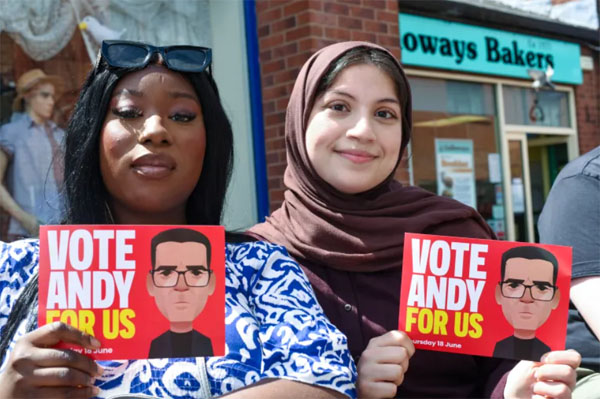
With the Makerfield by-election drawing close (only 10 days to go), one might have thought that the legacy media might be ramping up its coverage on the main challenger – Reform-UK – now that they have effectively abandoned further coverage of Henry Nowak for the time being.
It strikes as a reflection of the utter venality of the legacy media therefore, when the dominant Reform-related theme is a plea from the crook Zelensky for the party to overturn the decision by some Reform UK councils to take down the Ukrainian flag.
The initial story comes from the Guardian based on an interview with the Ukrainian president, when he warned that taking down the flag was the kind of “small mistake that can break a big friendship”, as he underlined the significance of strong bilateral relations.
According to the Guardian, Zelensky tempered his rare foray into UK domestic politics by stressing how much the two countries “need each other” in the battle against Russia, which he said posed a threat not only to Ukraine but to Britain too.
Whether or not he is right, this is no business of local authorities, who need to focus on the administration of their districts rather than making grandiose gestures. Thus, for once, I agree with Reform’s stance but also take the view that is it a very minor issue which hardly warrants the intervention of the Ukrainian president, much less the amount of attention given to it by the media.
That apart, it is very difficult to find anything of interest about Reform relevant to the coming by-election, which is perhaps suggestive of the calm before the storm, or merely a reflection of the fact that the media have already exhausted themselves and run out of things to say.
Turning to the social media, we have the second (updated) prediction on X from GB Politics, which puts Labour in the lead with 38 percent and Re-fuk tailing three points at 35 percent.
In a finding that will worry the Reformists, if they take this poll seriously, is that the support for Lowe’s Restore Britain which previously stood at 8 percent has now ballooned to 19 percent – more then enough to rob Farage and his not so many men of a victory.
As for the others, the Lib-Dems get 3 points, the Greens 2 and the Tories limp in with a mere one percent. Whichever geniuses thought it a good idea to have a black Nigerian as leader of the Conservatives clearly didn’t have in mind the idea of clawing back a respectable vote in former Labour strongholds.
There is, incidentally, also a Survation poll, updating its previous effort which put the Manchester mayor narrowly in the lead with 43 points and Reform’s Robert Kenyon trailing three points behind with 40 points.
The news of the moment then (on 24 May) was that Restore had Hoovered up 7 percent of the vote, even then potentially depriving Reform of a victory, but the current poll is the bringer of even worse news for the insurgent party.
This time, the gap has widened with Labour on 49 percent and Reform falling back to 39 percent. Restore comes in with 8 percent, only a very slight improvement and not enough to deprive Kenyon of the seat. According to this poll, he is going to lose it anyway.
Once again, in a dismal showing, the Tories only claw one percent out of the poll, which is an interesting reflection of the nature of electoral contests as Tory candidate, Michael Winstanly, is probably the best of a bad bunch.
The findings of these polls are, of course, extremely fragile. Survation, currently relying on a sample of 518 respondents, admits to an error range of up to 4.8 percent, which means that not too much note should be taken of what are highly volatile results.
In any event, it’s a very odd election where, in order to damage the current Labour prime minister, voters must actually vote Labour in order to bring about a leadership challenge. It is hard to discern what effect this might have on the current polling, even though Burnham is now promising he will launch a leadership bid within two weeks of him becoming an MP, if he wins.
Badenough, on the other hand, is struggling to make any progress but she has decided to take on Reform with a promise to scrap the duty on public bodies to consider how they can promote equality, thus presenting her party as responsible but also in tune with populist anger.
She will commit, we are told, to scrapping the public sector equality duty (PSED), a legal requirement obliging those bodies to think how they can improve society and promote equality in their day-to-day business.
That, apparently, will be the substance of a speech she will deliver today, when she is to claim that “dangerous and divisive agendas” are being advanced through the use of this key section of the Equality Act, affecting public bodies from the police to the Bank of England.
If voters take any notice of her campaign against what she describes as “identity politics”, she might succeed in positioning her party between Labour, which she accuses of wanting further “DEI bureaucracy”, and Reform, which has pledged to scrap the Equality Act altogether.
Whether this will have the slightest impact on the by-election is somewhat doubtful but, in theory, Reform should be on a roll as being the first party in the field to pledge to undo the effects of the woke mind virus.
This, though, is to reckon without the venality of the legacy media which has picked up on some of Kenyon’s more unfortunate social media posts, from 15 years ago. These are being taken to represent his “misogynist” views, anticipating that this will turn off women voters – a hope supported by the Survation poll finding that Andy Burnham’s lead among Makerfield’s women is emphatic.
The main battle, though, is on the Right, with multiple calls on social media for the right to unite, in the expectation that Lowe will stand his troops down. An unrepentant Lowe, on the other hand, is calling for Reform to stand down.
To that extent, regardless of the actual outcome of the by-election, pundits will be scrutinising closely the performance of Reform Britain. If the party does well enough to deprive Reform of its victory – assuming that Labour’s lead narrows – it will doubtless spark a robust debate between the warring factions.
Against the longer timescale of the 2029 general election though, this divide may have less impact than anticipated. Pete points to some fatal flaws in the makeup of Restore which, neglected by Lowe, could wipe out its electoral pretensions.
Should that clear the decks, that would leave the battle for the Right between Reform and the Tories but, with the Tories hardly qualifying as a party of the right, this might turn out to be a rather uneven contest.
Even then, in the event of a hung parliament, there is still the prospect of an unholy alliance between Labour, the Lib-Dems and the Tories, forming a party of national unity, mirroring some of the local council arrangements we have seen since the May elections. It seems that some uniparty politicians hate Reform more than they do each other.
And that might define the nature of our politics to come where choices are no longer dictated by preferences but driven by hatred of the alternatives. He (or she) who is hated least shall take the crown.
