
Politics: fuelling the fires
By Richard North - June 10, 2026
Just when I thought it was safe to write about pedestrian things such as electoral politics, up pops a random Sudanese asylum seeker (probably a Mohammedan) doing his best to chop the head off a Northern Ireland citizen, only to precipitate another social media storm and legacy media frenzy.
With the maelstrom precipitated by the Henry Nowak scandal barely subsided, we have scarcely been able to draw breath, leaving the politicians struggling and failing to control the narrative, the hapless Hilary Benn, Northern Ireland secretary, bleating that “there is no place for violence on our streets” (apart from random Sudanese asylum seekers doing their best to chop the heads off Northern Irish citizens).
With nothing much else on offer, he could only tell the Commons: “All of us have a responsibility now to urge calm”, thus launching into full-scale damage control mode – each attempt to control the narrative weakening as the slaughter on our streets intensifies.
When Jim Allister, Trade Unionist Voice MP for North Antrim, was indelicate enough to ask: “what will be done to stop the importation of an alien culture that thinks it is appropriate to try to behead someone within the United Kingdom”, Benn – not half the man that his father was – choked with indignation,
He was “sorry” Jim Allister had used the words “alien culture”, asking “what exactly is he referring to?”. Attempted head chopping, in Benn’s view, was just part and parcel of the rich pageant of “violence against citizens of the United Kingdom” perpetrated “by anyone, from wherever they come and whatever their background”.
It was that “violence”, sui generis, to which “we together are strongly opposed to”. Implied was the rebuke, that it didn’t matter who perpetrated it. How dare Allister even suggest that we had barbarian head choppers in our midst.
Faced then with Gregory Campbell, DUP, East Londonderry, stating that, as tension rises, “we now need to see Government action to restrict and inhibit people arriving in this country illegally, some of whom carry out actions like we saw on the streets of Belfast last night”.
To this Benn responded with what even he must have known was a lie, declaring that “any foreign national, regardless of how they came, who abuses our hospitality and commits crimes can expect to be deported at the end of their sentence”.
That opened the way for the odious Shoktat Adam, the Muslim member for Leicester South, to refer to the one and only Saudi student stabbed in recent years, using the staggeringly unrepresentative example airily to declare that: “It does not matter which background people come from. It is the responsibility of Members of this House to temper the inflammatory remarks”.
And that, if anything, set the tone. The job of MPs is not to prevent the violence – it is to manage the response to it, with ministers ensuring that anyone who complains too robustly is locked up in our increasingly over-crowded jails.
Needless to say, Starmer was quick to respond, with a robotic statement condemning the “abhorrent scenes of violence”.
After what Sky News called “a knife attack” – elsewhere described as “an appalling act of extreme violence” – Starmer managed to muster enough energy to call it “horrific” and “sickening”, declaring, “I have absolutely no tolerance for abhorrent scenes of violence like this on our streets”.
Out on the streets of Belfast, they were having none of this cant, intent as they were on a different kind of violence. While the suicidally empathic first minister Michelle O’Neill was leading a debate in Stormont “about our inclusive society, our welcoming society”, denizens of the city were engaged in their traditional pastime of bus and car burning, with the occasional police car thrown in.
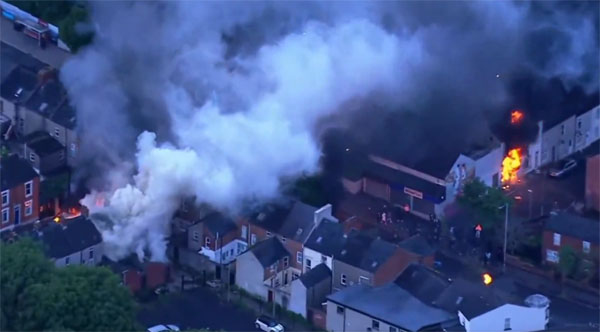
Rather more purposefully, a gang of at least 400 masked-up young men, armed with petrol bombs and other weaponry, were going door to door, turfing immigrants out of their HMOs and setting fire to them.
After the demonstrations at Epping’s Bell Hotel against concentrations of asylum seekers, neatly bottled up in identifiable locations, ministers no doubt thought they were clever, mounting their “Operation Scatter”, dispersing the migrants in small packages to HMOs in the “communities”. But the downside (for them) is that the police can’t watch them all. And yesterday, some were burning.
Some 20 miles down the road in Ballyclare, in County Antrim, protestors attacked a Turkish barber shop. The shop’s front door and windows were smashed, with Alderman Lewis Boyle saying the “violence and destruction” in Ballyclare benefits no one.
But it does. As previous riots – and even the Troubles – have shown, when governments become sclerotic and unresponsive, violence becomes the only way of reaching them. And in this case, focused directly at the immigrants rather then the police, it sends an unmistakable message which will be far more effective than the bleating of politicians.
Doubtless benefitting from the experience of the Troubles, the protesters are way ahead of their counterparts on the mainland, in terms of tactics. The PSNI reports “sporadic pockets of disorder” in a number of locations across Northern Ireland. The protesters are dispersing their efforts, thinning out the brute power of the police and stretching the resources of a force which cannot be everywhere all the time.
This also recognises that the police are not the enemy (so much) and attacking them with wheely bins and traffic cones simply plays into their hands and gets people locked up. By contrast, the Northern Irish seem to use localised riots as diversions, sucking in the police and absorbing their effort, while the real action goes on elsewhere.
The Guardian describes one scene, a residential street draped in loyalist flags near Belfast’s Shankill Road.
Masked men approach a house with a boarded-up window and a security camera stationed outside. As a woman from an ethnic minority background looks down from an upstairs window, some of the men rush the front door and break it down. With the air thick with smoke from fireworks, they attack the downstairs windows with bricks.
Nearby, a car is set on fire. A man in a skull face mask tells people to put their phones away. Helicopters circle overhead, and two police officers look on from their car as smoke billowed towards the sky – but appear to conclude that it was not safe to intervene. By the time reinforcements arrived in four police vans, most of the hundreds-strong crowd has melted away, leaving only a few stragglers in their wake.
With weary predictability, the national politicians are piling in, with Benn condemning this “thuggery”, saying there is “no justification” it, calling for an immediate end to the violence.
In some places, heavy rain did bring an end to the violence, for the moment. But this is just the start. The politicians, with their tone-deaf response to the legitimate concerns about mass migration, have lost control of the narrative.
The density of low-IQ third-world savages has reached a critical mass. Murderous incidents are breaking out at such great frequency that they can no longer be brushed aside. Like London busses used to be, you wait forever for one and then they all arrive at the same time.
Although there have been protests on the mainland, as far apart as Southampton, London and Glasgow, they have been less intense. Typically, the Guardian calls the “knife attack” a trigger event and blames social media for enabling far-right agitators to mobilise internationally.
It’s far more than that. This is real people reacting to their streets being turned into charnel houses, and being ignored by preachy politicians who are making not the slightest attempts to stem the “invasion” of third-world murderers, rapists, robbers, shoplifters and sex pests.
Gradually, the mainland British will learn from their counterparts in Northern Ireland and their tactics will improve. Says one commentator on X, “The OpSec shown in Belfast is next level. No faces recorded, no inchorent (sic) rage but lots of directed rage. No broadcasting organisation, but it was very evident. This tradecraft will spread across Britain. Establishment nightmare”.
Relying on the dictum that “there are more of us than there are of them”, it will only be a matter of time before a disillusioned, demoralised and badly-led police force loses control of the streets.
Then, the work that the politicians are afraid to do will start. If Henry Nowak was the turning point, Belfast is the accelerant that will fuel the fires of dissent. Starmer and his motley crew cannot even begin to imagine what is coming.
