
Politics: this poisoned chalice
By Richard North - June 21, 2026
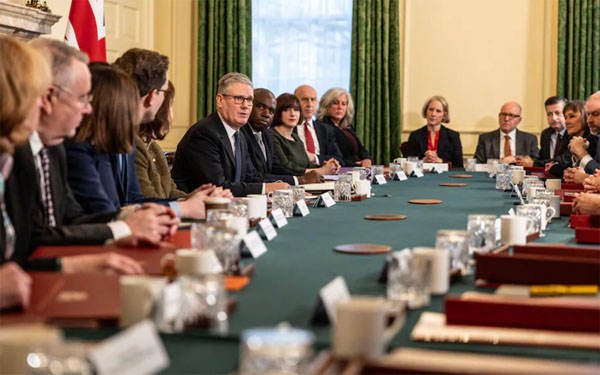
If we are to believe the flurry of media reports, Starmer is on his way out, officially set to resign. He is said to be consulting with his wife and family today and we are told to expect him to outline a resignation timetable tomorrow.
This, apparently, is not a voluntary departure. But, according to the Independent (and others), he is facing “a hard deadline” of Tuesday morning’s cabinet meeting to make an announcement, so we might be hanging about all day tomorrow with nothing very much happening.
However, you will struggle to find any media which is not suggesting that Starmer’s imminent departure is a done deal, so much of the focus now is on the successor.
If there is a leadership contest, then we could see what would be a lame duck prime minister hanging on through the summer, with his replacement only taking over in time for the party conference in September.
To short-cut this process, the Independent is telling us that allies of Andy Burnham are plotting to ensure he is installed as Labour leader quickly in a coronation rather than contest, with pressure on Wes Streeting and other potential candidates to strike deals and not try to force a contest.
Yet, for all that, Sky News is telling us that No 10 is saying that Starmer intends to fight on, although the chance of this happening is put at 25 percent.
As part of the deal-making, the Burnham camp is reported to be offering Starmer uncontested tenure until September, allowing him to cement in what passes for his legacy, rather than being dumped unceremoniously and being replaced by a caretaker prime minister while the leadership contest is under way.
If Starmer bites, we doubtless can expect an uptick in the already extravagent air miles ration, as he seeks to plant images of him consorting with foreign dignitaries in a bid to be remembered as an international statesman – with a particular emphasis on Ukraine – rather than as a failed prime minister.
Since the Makerfield result, where the strength of Burnham’s victory has convinced over 100 Labour MPs that it is time for a change, this manoeuvring has a certain tedious predictability and the nation’s media takes time off from serious politics (not that it spends much time there anyway) and indulges in its favourite pursuit of “guess the next leader”.
So far, its second-favourite pre-occupation – the date of the next general election – has not had too much of an airing, although there is still an outside possibility that Starmer will bring the temple down upon himself by calling a general election.
With the Right seemingly in disarray – with no sign that unity is on the cards – Starmer might even believe that Labour could win the election under his leadership, thereby frustrating his critics by keeping himself in place until after the turn of the decade. With Starmer, you just can never tell.
As to Burnham, should he acquire the mantle of leader, it may be that he faces calls for a general election and there is every reason why he should agree. Having not even been an MP at the last election, the man has absolutely no mandate and, despite his grandiose rhetoric, cannot claim that his regime would have any legitimacy.
If ever there was a time for directly elected prime ministers, this is it. We are getting to the point where holding office as prime minister has become a temporary post, with the electorate ending up with office holders that do not even have the wafer-thin authority of being leader at the time of the election.
With still three years to go, though, Burnham seems unlikely to risk an election – especially if he thinks there is a chance of him losing. Nevertheless, if Burnham gains the keys to No 10 via the coronation route, he doesn’t even have the fig-leaf of a leadership election to afford his plans some legitimacy.
This, of course, is where we are being badly let down by the media and the political punditry. Rather the immersing themselves in the soap opera, they should be focusing on something which looks suspiciously like a bloodless coup and asking by what right the beneficiary of this process has to take over the job of prime minister.
Such qualms, though, tend to be universally ignored, as is the irony of a situation where a new political leader is being appointed to guide the nation through a period of crisis and the electorate is excluded from the process and forced to stand on the sidelines as passive observers.
There was already some unease at this carousel, after the Oaf Johnson had been ditched, only to be replaced by the hapless Liz Truss and then the immigrant-stock Sunak – all without the scintilla of a democratic process. But now history is about to repeat itself, one wonders whether the imposition of yet another leader will bring us closer to David Betz’s predictions.
Laura Kuenssberg, in her weekly column for the BBC website, starts by quoting a long time Labour adviser who, with exasperation in his voice, says: “We promised people we weren’t going to do this”.
But as every hour passes, she writes, it is more likely the UK will soon have its seventh prime minister in 10 years. “Talk of Sir Keir Starmer fighting is fading, his exit seems more likely as the weekend goes on. The prime minister is at his country retreat, Chequers, spending time with his wife”.
Here, one might recall the famous comments of her predecessor, Andrew Marr. Speaking on BBC Question Time immediately following the July 2024 general election, he noted that, “For the first time in many of our lives, actually Britain looks like a little haven of peace and stability”.
Marr argued that this newfound political calm would contrast sharply with the preceding years of Conservative leadership and would help “draw money” and global investment back into the country – a prediction so wide of the mark that only an ex-BBC employee could have made it.
But when, despite a 174-seat majority, the new Labour government could not offer us either peace or stability, and we are about to be plunged into a new round of uncertainty, public tolerance may be fraying at the edges.
Should Burnham take the crown and then be forced to impose some unpopular measures – which doubtless he will – this could be enough to tip the nation into a state of sullen resentment which, in the febrile mood of the times, could evolve into something far more serious.
But, for the moment, we have no option but to stand as impotent spectators as the soap opera plays out, coming to terms with the fact that we may be in the throes of having a new prime minister foisted on us, on the basis of 25,000 votes cast in the Makerfield by-election.
And since this has become a mechanism for changing prime ministers, there is always the possibility that MPs will prefer this to the more arduous and uncertain (for them) process of the general election.
The only slight consolation is that we seem set to be rid of the most unpopular prime minister in living memory but, since there is no guarantee that his successor will be any better, this is very thin gruel indeed.
Understandably, many people have switched out of the political process and it is difficult to blame them when our politicians treat their electorates with such disdain, but even a passive population has its breaking point.
Burnham, if his coup does succeed, may find he has inherited a poisoned chalice, Shakespeare’s even-handed justice that he will most wholeheartedly deserve.
