
Defence: DIPsh*t
By Richard North - July 1, 2026
Well, the long-awaited Defence Investment Plan (DIP) has been published, bringing the defence “community” out of their holes to dissect it.
Generally, I find this specialist commentariat a bit cliquish, over-fond of jargon, and not entirely lacking in pomposity and self-importance. And while they do occasionally provide some entertainment, their reviews and analyses of this publication are largely a waste of time. Almost to a man (and woman), they are largely missing the point.
The DIP itself is supposed to put clothes on the Strategic Defence Review, defining the projects that will make it work and thereby allocating the cash from the defence budget.
It is the focus on spending – and the projects that will be supported (and cancelled) – which derails the discussion, primarily because the DIP is the child of the SDR and entirely subordinate to it. And, as I wrote some little time ago, the SDR is a bag of spanners.
We really need to go back to the drawing board, I wrote. Even the lessons from the current situation in Ukraine might not hold good, given the speed of technological evolution and operational development. We need to set up systems which can cope with this volatility, keeping our armed forces relevant as the nature of the threats change (assuming we’ve assessed the threats correctly – which we haven’t).
Underwriting the current debate, though, is the underlying assumption that the SDR is basically sound, so that discussion tends to be on points of detail rather than on the bigger picture. And behind that is the basic assumption that the authors of the SDR – and the many “experts” who contributed to it – knew what they were talking about and were offering a sound basis for the UK’s defence.
In terms of procurement, though, time and time again history has shown the MoD – and its predecessor organisations – the military and the ranks of “experts” to be incapable of accurately defining future needs, producing a succession of expensive disasters which left our armed forces unprepared and ill-equipped.
More recently, I had a quick look at some of those disasters spawned by the Air Ministry in the run-up to WWII, remarking that, if we had relied on Air Ministry procurement to fight the Germans, we would have lost the war.
In a sense, though, it is almost unfair to pick on the Air Ministry because, when it came to producing lemons, almost nothing can compare with the disaster-prone attempts of the War Office to procure a suitable tank for the Army in the early stages of the war.
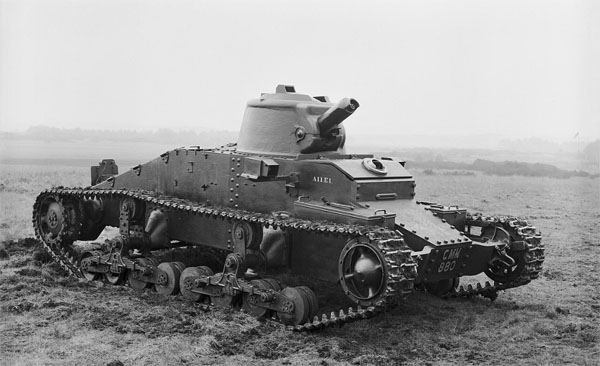
At the beginning of the war, the fruits of its efforts were represented by the Matilda Mk I, with provided the mainstay of the British armoured forces despatched to France in 1939, as part of the BEF.
Built down to a price to cope with defence budget restrictions, the initial order had been placed in April 1937 and the tanks remained in production until August 1940, with a total of 140 produced, including the prototype.
Slow, cramped and armed with only a single machine gun (mainly a .303 Vickers – a few were fitted with .50 cal guns), the lack of an anti-tank capability severely limited its utility on the battlefield.
With two crew and poor ergonomics, it was a difficult machine to use. Besides the machine gun, the commander had to direct the driver and operate the radio. Too bulky for the turret, the radio was located in the hull; the commander had to duck down inside and lie almost prone to operate it. The driver’s position was equally cramped and the turret could not be traversed forward while the driver’s hatch was open.
Essentially, this was a First World War tank designed twenty years after its conclusion. The designers had been influenced by the mistaken belief that combat in a new war would be the same as in World War I, in which tanks were used for breaking through strong, static defensive positions.
With a top speed of 8 mph on roads, it was thought to be sufficient for supporting an infantry advance. As a result, the tank was obsolete both in design and in its intended purpose before it even entered service.
As to its combat record, the 58 Matilda Is deployed to France spearheaded the counter-attack in the Battle of Arras on 21 May 1940 and met with limited success. But, by the following day, only 26 were still serviceable. Most of these were abandoned in France and the 77 left in the UK were withdrawn and used only for training purposes.
This, however, merely reinforces the point that government agencies are well capable of making huge blunders when it comes to preparation for war. The failures continue to this day and it is my view that the MoD is on the cusp of making yet another of its sizeable blunders.
The crucial issue here is not so much the equipment that the MoD is considering, with a strong emphasis on “the lessons from Ukraine”. There are no fewer than 40 mentions of Ukraine in the DIP. Much of the response relates to the provision of drones (“uncrewed systems” as the DIP calls them), with a promise of expenditure of £5 billion, covering all three services – air, sea and land.
The problem, though, lies elsewhere, instanced by the assertion that “A major lesson from Ukraine is that when a country is under threat or forced to fight, its Armed Forces are only as strong as the industry, innovators, and workers that stand behind it”.
Thus, we are told, the government is pursuing a new partnership with industry, as outlined in the SDR, with the expectation that “this new investment plan will boost productivity and investment, by 2029/30 supporting nearly 60,000 additional UK direct and indirect jobs.
With Ukraine experience in mind, the government here seems to have learned entirely the wrong lessons. Such is the pace of technological development on the battlefields that special arrangements have emerged.
In respect of drones (but also much else) the development and final stage of manufacture is vertically integrated with active units, with service personnel under unified command engaged in all stages of the work – often close to the battle areas in fortified bunkers.
This ensures that there is direct feedback from operations and a very short line of communication. Only by this means can the tempo of the development cycle be maintained, with innovations reaching the front within weeks of being mooted.
This is where the UK has not learned the lesson. In such an environment, the traditional British procurement system (common to many armies) simply will not work. Separation of development and manufacture, and the bureaucratic procedures that stand at the interface, will not enable the frenetic pace of development which is essential to the conduct of this war.
Thus, the advent of drones has heralded not only revolutions in hardware and operations but also fundamental changes in the way wars are prosecuted. To survive in the wars for which the MoD is apparently preparing, there must be a complete restructuring of the military, and the way equipment is procured, with the cycle cut from decades to weeks.
In a way, though, there is nothing new here. We saw something of this in WWII, where operational units very often had their own engineering/development capabilities in the field (or were very close to them).
A classic example was the development of the Rhino tanks in the Normandy campaign, fitted with tines which were used to cut through the bocage hedgerows and restore mobility to armoured forces.
The modification originated in the field (Sgt Curtis G. Culin of the 102nd Cavalry Reconnaissance Squadron). The tines were manufactured locally by slicing up scrap metal from German “Czech hedgehog” anti-tank beach obstacles and welding them onto the fronts of M4 Sherman and M5 Stuart tanks.
From the first demonstration of the system on 14 July 1944, the First US Army manged to manufacture and fit hedgerow cutters onto over 500 Allied tanks in a mere 11 days – roughly 60 percent of all US front-line armour – preparatory to the launch of Operation Cobra.
At the start of the Ukrainian war, no one could have predicted in detail the way the conflict would develop on the ground and, in an era of technological flux with AI finding its way to the battlefield, there is no reason to expect that the pace of change will slacken.
Yet, what the SDR/DIP is doing is forcing the military to take a punt on the unknown and attempt the impossible by defining the equipment and systems it will need for a conflict in the indeterminate future.
What the forces need is not rows of shiny (and expensive) new toys that could be obsolete by the time they are used, but the ability to respond rapidly to the demands of warfare in real time, enabling them to field kit rapidly on the scale needed, at a cost that can be afforded.
For all that we now have the DIP, I see nothing there that will make this a reality.
