
Defence: pig in a poke
By Richard North - July 2, 2026
All too quickly, the defence “debate” – such that it is – has narrowed in the legacy media to become another soap opera episode, this one centred on Starmer dumping the cost of the DIP on The Replacement – who will have to find the money by making unpopular cuts elsewhere (or by increasing taxation).
Apart from limited coverage of the proposed Royal Navy capabilities, though, there has been very little critical evaluation of the capabilities that the defence budget is buying – under the direction of the DIP (in turn guided by the SDR) – which will determine the effectiveness of our armed forces as war-fighting machines.
In the absence of an informed debate about the capabilities the taxpayer is being asked to fund, we stand at risk of paying for something that doesn’t do the job, whence the argument about the cost of the defence budget becomes irrelevant. Any amount of money spent will be wasted on what amounts to a pig in a poke.
Each of the services, of course, have their own particular roles and, in theory, will determine their spending requirements on the cost of the resources needed to fulfil their warfighting tasks. That, at least, is the theory.
In the case of the Army, however, there are very clear indications that planners are defining the force structure, equipment and then roles, to fight hypothetical battles which they prefer to fight, without reference to the realities on the ground.
The net effect of this bizarre situation is to mirror the scenario I described yesterday where the War Office in the run-up to WWII equipped its Army with a tank (the Matilda I) for an imaginary 20th Century trench breakthrough, oblivious to the doctrinal changes which were driving the German army.
That this is about to happen again is essentially confirmed by the DIP which tells us (para 58) that the British Army is transforming from a force optimised for the expeditionary operations of the post-Cold War era to a fifth-generation modernised force designed for NATO warfighting, as outlined in the SDR.
The Defence Investment Plan, we are informed, will multiply the Army’s lethality, founded on the Army’s new doctrine of fighting by “recce-strike” at every level – from corps down to platoon – and underpinned by the widespread adoption of autonomous systems and AI.
Taken together, the DIP says, these new capabilities will deliver a transformed Strategic Reserve Corps for NATO, essential for the defence of the UK and NATO territory.
This passage, based on the extravagent claim in the SDR that the lethality of the Army will be increased 10-fold, is entirely reliant on the doctrine labelled “recce-strike”, claimed fundamentally to change how the Army fights.
But, in the passage as a whole is buried the delusional assertion that the British Army is transforming from a force optimised for the expeditionary operations of the post-Cold War era to a fifth-generation modernised force designed for NATO warfighting.
The first point which needs challenging here is that the British Army was never optimised for expeditionary operations. It fought the two campaigns against the Iraqi army with existing equipment designed primarily for meeting the Warsaw Pact threat on the plains of Northern Germany.
It then fought (and lost) two vicious insurgencies (one in Iraq, the other in Afghanistan) with an order of battle cobbled together from existing equipment, largely inadequate for the purpose, latterly augmented by a limited amount of specialist equipment, which came too late in the day to affect the outcomes.
It was around that period – at the tail end of the Blair administration – that the expeditionary concept came very much to the fore, fuelled by the EU’s grandiose ambitions to field a rapid reaction force capable of armed intervention anywhere in the world, paralleling Nato ambitions to establish an out-of-area force in order to shore up its relevance in the wake of the collapse of Soviet Union.
Across the Atlantic, similar thinking had generated in the US the Future Combat Systems (FCS) announced in 2003 and a means of implementing the Revolution in Military Affairs (RMA), enunciated in 1999.
The FCS was centred on strategic deployability, with the core requirement that an entire brigade’s vehicles must be light enough to be flown anywhere globally on standard C-130 or C-17 transport aircraft.
The lightly armoured vehicles (necessitated by the need for air mobility) were to be protected by an “information shield” – high performance sensors which would detect enemy activity before it came close enough to cause harm, coupled with an electronic (“net-centric”) network which could rapidly communicate data to a range of stand-off weapons which could neutralise threats before they came any closer.
The project was widely regarded as the largest, most expensive, and most disastrous procurement failure in modern US military history. The outcome was its total cancellation in 2009 by Secretary of Defense Robert Gates, after the government had spent roughly $18-32 billion with virtually no fieldable hardware to show for it.
But this was not before the MoD came up with its own version of FCS, which it called FRES (Future Rapid Effects System), originally identified in the 1998 Strategic Defence Review (SDR) but not formally launched until May 2004. It aimed to procure between 3,000 and 4,000 vehicles across 16 different battlefield roles, with a budget of up to £16 billion – the largest single procurement project in the history of the Army.
For the same reasons that FCS failed – with the realisation that relying on a digital network as your primary form of armour works perfectly on a Microsoft PowerPoint slide but fails catastrophically on a real battlefield – FRES ran into the dust and had been completely abandoned by 2012 after the expenditure of hundreds of millions.
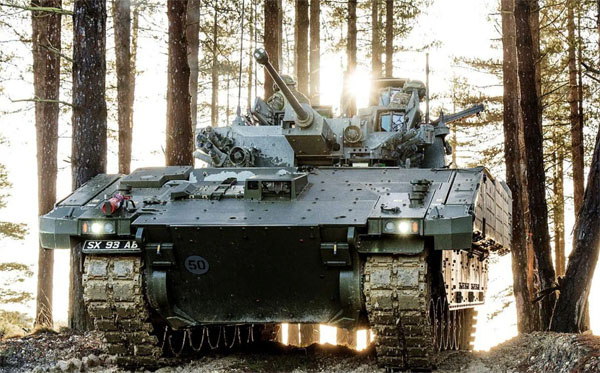
However, there were two survivors from that project, the AFV which was to become the Ajax reconnaissance vehicle, and the Boxer APC. The Ajax was then to become the heart of a redefined FRES project, adapted so that the net-centric strike capability became an offensive tool in a system now renamed “recce-strike”.
Thus, what we have, in effect, is a concept more than a quarter of a century in the making – one that is conceptually flawed and has been abandoned by its principal authors. But it has been exhumed, dusted off and given a lick of paint to masquerade as a “fifth-generation modernised force designed for NATO warfighting”.
For all the apparent modernity, the Ministry of Defence’s strategic blind spot remains unchanged since 1937: it is attempting to pre-define and build rigid, multi-billion-pound systems for a hypothetical future war that it wants to fight, rather than fight the actual war on the ground where the enemy gets a vote.
But after spending over £6 billion and wasting twenty years, the political and institutional cost of cancellation is too high. The British Army is fielding Ajax not because it is the right weapon for Ukraine-style warfare, but because it is the only new weapon they have in their inventory.
Yet, generating an acoustic signature that could be detected from outer space, the survivability of Ajax on the battlefield – realistically – must be measured in minutes.
But the Army argues that Ajax is not meant to sit on the zero-line at the forward edge of the battle area. It intends to keep it 15 to 30 kilometres back from the physical front line, using its five-mile mast optics to peek into the contested zone.
The Army believes that at this distance, its physical noise will fade into background terrain noise, and its thermal signatures can be hidden by advanced camouflage nets, while its electronic emissions can be concealed by advanced electronic warfare measures.
Their plan assumes that British jammers will cleanly sever the enemy’s drone links and blind their sensors, allowing the noisy, 42-tonne Ajax to move safely in a “blinded” zone.
This ignores the reality of peer conflict (vividly demonstrated in Ukraine) which shows that EW is an aggressive, rapidly evolving game of cat-and-mouse. A peer enemy will not simply allow their sensors to be jammed.
They will use electronic counter-countermeasures (ECCM), deploy fibre-optic or autonomous drones that fly without radio links using visual AI targeting, or use anti-radiation missiles to trace the British jamming signals back to their source and destroy them. The moment that electronic shield fluctuates, the hyper-transparent battlefield returns, and Ajax is exposed.
What the Army it is doing, therefore, is rewriting doctrine to fit the hardware. Because the Army has Ajax, it must create a concept (Recce-strike) where a heavy, noisy, tracked vehicle is somehow deemed useful and survivable, even when real-world data from peer conflicts suggests otherwise.
The worry of this is that no-one seems to be noticing. The core doctrine of the Army, on which the SDR relies to achieve the necessary “lethality” from a shrunken force, is so transparently unrealistic that it has no hope of delivering what is claimed for it.
Only through a complete absence of understanding could this be imagined as a “new way of warfare”, yet the Army is being given a free pass by the media and commentariat, ensuring that a future Army is unable to fight successfully against a peer adversary – irrespective of funding levels.
