
Defence: the reality gap
By Richard North - July 24, 2026
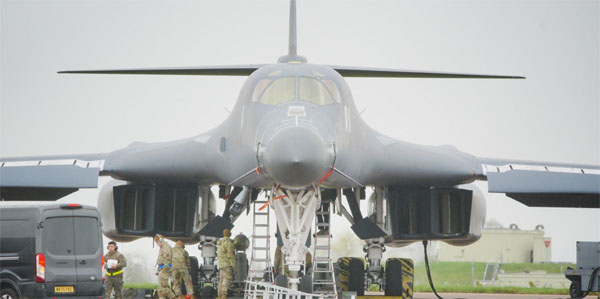
We’ve been here before, and covered the issue at length, particularly here. But the issue – and the lies – won’t go away.
Following the use of RAF Fairford to launch a USAF B-1 attack on Iran, the Islamic Revolutionary Guard Corps has declared that “any base used for aggression against Iranian territory constitutes a legitimate target for our forces”.
The statement was published on the IRGC-linked Tasnim news agency, with the Guard specifically identifying the use of RAF Fairford, thus making it clear that it did not rule out mounting a direct attack against the air base.
In theory, the Iranians could launch an attack using one (or several) of its
Khorramshahr-4 (Kheibar) Intermediate Range Ballistic Missiles (IRBM), which has a range of approximately 2,700 miles with a reduced warhead weight (about 1,500 lb).
According to official Iranian claims, this missile has an estimated accuracy of 10-30 metres Circular Error Probable (CEP), although it is probably closer to several hundred metres, or up to 1,500 metres if relying strictly on fallback inertial systems. Even at worst, it could still hit something the size of RAF Fairford.
In response, a spokesperson has issued a statement for the government saying: “Our armed forces are ready to keep the United Kingdom safe from any kind of attacks, whether it’s on our soil or from abroad. The UK stands ready 24/7 to defend itself”.
The statement continues: “This includes through operating a layered approach to air and missile defence, provided by Royal Navy, British Army and Royal Air Force assets equipped with a range of advanced capabilities, working closely with our Nato allies”.
It then concludes: “We are committed to defending our people, our interests and our allies, acting in accordance with international law and not getting drawn into the wider conflict”.
Read casually – or even carefully – the impression given is that the UK is capable of defending itself and our armed forces have the wherewithal protect us from an Iranian attack. The Independent goes so far as to say, “UK ready to shoot down Iranian missiles after Tehran threatens RAF base”.
This is not the first time that HMG has sought to give this impression, although last time it was Starmer and his defence secretary Healey who were doing the misleading. But now, with a different cast of characters – under the leadership of Burn’em – the message is the same.
But, as I have made very clear in previous pieces, the UK has no organic, sovereign capability for intercepting IRBMs. Against a weapon traveling at hypersonic speeds (Mach 5+) on a ballistic or manoeuvring trajectory, the UK mainland is fundamentally exposed.
The Army’s primary ground-based air defence system, Sky Sabre, is highly advanced but strictly designed for short-to-medium-range threats like jets and cruise missiles. It has zero capability against high-altitude ballistic or hypersonic missiles.
As to the Royal Navy, its only potential capability is the Type 45 Destroyer which operates the joint European-venture Sea Viper (Aster 30) system. While highly effective against subsonic and supersonic anti-ship missiles (as proven in the Red Sea), the current fleet cannot intercept hypersonic IRBMs.
Furthermore, usually only one or two of these six warships are actively deployed at any given time and, to be effective – assuming it did have an IRBM capability – a ship would have to be stationed in the eastern Mediterranean, preferably in the Aegean, close to Venice, to get a decent shot at a mid-phase intercept.
That leaves the RAF, which has no weapons at all with which it could shoot a missile down. Its only contribution could be the operation of massive Ballistic Missile Early Warning System in Fylingdales, North Yorkshire. This radar can detect and track an incoming IRBM within seconds of launch, but it is purely a passive observer.
The only clue as to where our safety (such that it is) actually lies, is in the phrasing tucked away in the statement with refers to us “working closely with our Nato allies”. That phrasing, to say the least, is disingenuous. We are not so much “working closely” with our Nato allies – we are entirely dependent on them.
As I pointed out earlier, such protection as we do enjoy comes from the US-operated European Phased Adaptive Approach (EPAA), with the two land-based Aegis Ashore sites in Deveselu, Romania and Redzikowo, Poland, backed up by a fleet of five Aegis-equipped Arleigh Burke destroyers (with one added in Autumn 2024).
Although the ships are based at the naval station in Rota, Spain, three are currently deployed in the eastern Mediterranean, which is just where they need to be in order to intercept missiles from Iran. All five are equipped with Aegis Baseline 9 and SM-3 Block IIA missiles, the combination being regarded as the “gold standard” for ballistic missile defence.
When to comes early warning radar, Fylingdales doesn’t play a role. To deal with a threat from Iran, the US Army operates a AN/TPY-2 X-band, high-resolution, phased-array radar, based about 59 Km west of the Turkish city of Malatya, roughly 700 Km from the Iranian border.
This is controlled by the Nato Integrated Air Defence System via the Allied Air Command at Ramstein Air Base in Germany, which coordinates the ship and shore assets to ensure the optimum firing solution for what could be multiple threats, from several different launch points inside Iran.
There is no shame in being thus dependent on the United States – the threat does arrive, after all, as a result of US action against Iran and the protection of RAF Fairford is as much in the interest of the Americans as it is ours.
And we do make a financial contribution to the “C2 Systems” – the software and hardware at Ramstein Air Base in Germany that links different national radars and weapons, providing the secure communication lines required to send tracking data from the radar in Turkey to a land or sea interceptor site within fractions of a second.
Thus, it remains a matter of puzzlement that the government feels it necessary to put on a show about us being able to defend ourselves by our own efforts, especially as the locations of the primary defence missile batteries needs to be outside the UK.
However, while the kill probabilities of this defence system are high, no system is considered complete without a point defence for sensitive or high-value targets, as a backstop, or in the case of defence saturation where Iran launches a cluster of missiles which temporarily overwhelm the defence.
This is where the UK is completely lacking. The government’s best option might be to go for its own Aegis Ashore installation. Two such could suffice, with a mix of longer-range point-defence SM-6 and SM-3 Block IIA missiles.
Here, one can see why the government wants to pretend that it is fully capable of mounting a defence. The additional provision would set the defence budget back about £4.5 billion. Missile costs would be vastly increased, with SM-6 at £10-12.5 million each and the SM-3s at a staggering £40 million a pop, bringing the 20-year lifecycle cost for each installation potentially to over £3 billion.
But where there is further potential embarrassment is in the government’s plans to upgrade the existing Aster missile system, building new-generation Aster 30 Block 1NT missiles. But while the performance might be comparable with the US system, the price lies in the estimated range of £2.1- 3.3 million, and an estimated 20-year lifecycle cost ranging between £1.13 and £1.5 billion.
To achieve the same coverage, though, five batteries as opposed to two Aegis installations would be needed, making it more expensive overall. And while the Aegis system is already operational, the earliest that Aster 30 might be ready is by 2035.
It might be germane for an opposition party to ask, therefore, why we are pumping development funds into a cooperative venture with Europe to provide us with a system that may be ready in a decade – which may (or may not) match the capability of a currently available US system which would costs less.
It might also be appropriate for the legacy media to ask some searching questions. The Telegraph currently notes that, shortly after the Iran war began, military chiefs said Britain was defenceless against potential Iranian missile attacks after Tehran tried to strike the joint British-US Diego Garcia military base on the Chagos Islands.
The paper quotes Sean Bell, a former air vice-marshal, who said Britain had Bloodhound missiles to stop such attacks during the Cold War, but its defences had waned since then because of a lack of investment.
“The worry here is that if Iran was to launch a ballistic missile that was heading our way, unlike Israel, unlike America, unlike Diego Garcia, we have no defences against that in this country,” he told the BBC in March, adding: “Whilst we could track it, it would be able to strike us”.
As long as the US EPAA system is operative, though, that isn’t strictly true – there is a good chance Iranian missiles would be intercepted. But the defences, lacking a point-defence backstop, are not as capable as they might be.
But, considering the amount we have spent on the Type 45 destroyer development, and other systems, shouldn’t somebody be asking why that is the case?
