
Politics: rebellion
By Richard North - June 11, 2026
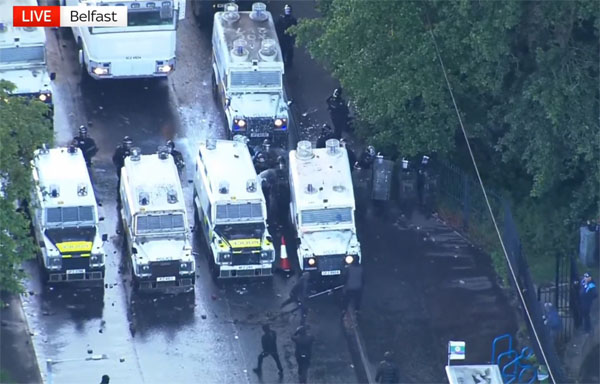
It was harder to work out what was going on yesterday evening in Northern Ireland. This is often the case when trying to follow events on X, as they mature. The previous day’s footage – some of it previously unseen – gets mixed up with current reports, the timeline gets blurred and the narrative becomes confused.
Given the discipline on the ground, where protestors are actively discouraging filming of their activities (they are not in it for social media clicks), and the hostility shown to the legacy media, there is very little new footage from which to base an overall view of events.
The only thing of which one can be certain is the protests continue through the second day. The PSNI are out in force in their armoured Land Rovers, with water cannon deployed. One gets the impression that they were caught out by the scale and ferocity of the protests on Tuesday night, but such footage as is available from yesterday seems to indicate a more organised response (pictured).
Whether this is the start of a long-term rebellion is, at this stage, difficult to tell, but with Northern Ireland, the peace settlement which brought the Troubles to an end, with the Good Friday Agreement, was always a thin veneer, especially in east Belfast which was at the heart of an insurgency which lasted 38 years and which, at its peak, soaked up 30,000 British troops.
A local writer, brought to my attention by Pete, who goes by the name of Sara Morrison, attempts an explainer which sketches a scenario which doesn’t bode well for long-term stability.
One thing that strikes home is that both Protestant working-class communities. and the Catholics from firmly Republican areas are saying the same things about migration, quietly, and “in ways entirely absent from their community’s public representatives and media”.
The grumbling, Morrison says, is real and it is on both sides of the peace wall. Yet, she adds, “Sinn Féin and the SDLP do not speak for all of their communities on this, and pretending otherwise will not make it less true”.
It is this sense of detachment of the political and media classes which is perhaps the most worrying thing about this current situation. You would think that the local elected officials might have their ears to the ground, along with the regional media, but that is not the case, leaving a dangerous vacuum which reinforces the perception of the grass roots communities that they have been abandoned.
But, Morrison notes, the tendency to call everyone who raises an uncomfortable question a “far-right grifter” is a closing move, not an argument. It hands every legitimate grievance directly to the people they claim to be fighting, she says, and it protects a political and media class from having to account for what was and wasn’t built here in twenty-eight years of peace.
It’s not much better at any level involved in dealing with the growing crisis. In an extraordinary naff intervention by some anonymous government agency, the family of the wannabe head-chopper’s victim, now identified as Stephen Ogilvie, was prevailed upon to issue a statement on the attack, shared via Phillip Brett, the Democratic Unionist MLA for Belfast North.
Fully recounted by the Guardian, the statement opened with the words: “We are completely devastated by the horrific attack on our loved one”, going on to say: “This has been a massive shock to our whole family, and right now our only priority is being at his bedside and helping him recover”.
From there, it descended into bizarre corporate-speak, declaring: “We are aware of the tensions and talk of protests following this incident. We want to make it absolutely clear that overnight unrest is not welcome, and peaceful protest is the only way forward”.
In like manner, it continued: “We have many migrants who make a deeply valuable contribution to our country, including in our healthcare system and hospitality sector, and we depend on them to make our country work. We do not want this terrible tragedy to be used to divide people or fuel hostility”.
The idea that a grieving family, still in shock from the recent, horrific events, should be so concerned with the migrant contribution to the hospitality sector that they should embed it in their statement is beyond absurd.
As a cynical Allison Pearson – Telegraph columnist – put it, “No normal shocked family sounds like this. This is panicking, stop the natives revolting, crisis-management speak”, before adding: “Shame on the state for putting words in the mouth of people whose loved one was almost beheaded”.
This is the classic liberal political class response, says Paul Embery. It wants us to treat atrocities like Belfast as single, random, isolated incidents. “Yes, it’s horrific, but don’t overreact,” they say. “Let the police do their job. Justice will be delivered. Let’s remain united”, and so on.
But the public can see that such incidents aren’t random or isolated. They are, in fact, all the consequence of massive state failure in the area of asylum and immigration. All roads lead back there.
That’s why people are angry. They are sick of the platitudes that get trotted out after each fresh incident. They don’t want to hear them anymore. They know that the decisions of establishment politicians have brought us to this current pass, and they don’t trust those same politicians to fix things, especially when some of them refuse to even recognise that the public’s anger is justified.
Westminster during PMQs saw this illustrated in spades. The robotic Starmer intoned that he had spoken with the First Minister, the Deputy First Minister and the Chief Constable, and the Secretary of State for Northern Ireland is meeting leaders in Belfast. “We are”, he said, “united in calling for calm and we are determined to restore order, support the police and all those on the frontline, and ensure that justice is done”.
Calm is fine from the safe distance of Westminster, but when you are on the front line, and find murderous Sundanese on the streets, not so much. Concern is intensified with the rumour that the perpetrator, Hadi Alodid, had once been part of an Arab militia counterinsurgency force in Darfur.
Known as the Janjaweed, Alodid and his fellow murderers would sweep into an area, killing and mutilating the men and raping the women in what has been called an ethnic cleansing of the Fur, Masalit, and Zaghawa people. Chopping off the heads of random Irishmen would seem like home from home.
PMQs was, of course, the opportunity for the leader of the opposition to skewer Starmer on his treatment of the crisis but, as she does so often, Badenough fluffed it.
Thanking the prime minister for his “short statement” she went on to say: “people have a right to be angry”, but “no one has a right to burn families out of their homes or to burn public property and attack the police”. We all have a duty to stand up for public safety in every way.
That was it. She devoted her allotted questions to the subject of the funding of the much overdue Defence Investment Plan, letting Starmer off the hook over the treatment of what was (and is) emerging as a grave crisis, leaving the opportunity hanging.
Michael Deacon in the Telegraph offered some clues as to how she might have handled the exchange, in his column headed: “Politicians only have themselves to blame for the Belfast riots”, with a sub-head reading: “This is what happens when, election after election, people vote for proper control of our borders and MPs keep ignoring them”.
After Vickrum Digwa was found guilty of murdering Henry Nowak, he wrote, Labour MPs were desperate to avert widespread public disorder. So they all started parroting the same line. Henry’s father, they repeatedly reminded us, had said: “We do not want his death to be used to create further division.” Therefore, Labour MPs sternly intoned, we must “respect the family’s wishes”.
To Deacon, on the face of it, this sounded like a perfectly reasonable request but he did have one small question. On 20 October 2024, Rhiannon Whyte – a 27-year-old woman employed at a migrant hotel in Walsall – had been stabbed to death with a screwdriver by a Channel migrant from Sudan.
And in March this year, 18 months on, the victim’s mother had demanded to know why so many Channel migrants were still being allowed not just to enter Britain, but to live here. “The Government”, said Siobhan Whyte, “should close the borders and send them back”.
From this emerged Deacon’s question: If Labour MPs believe it’s essential to “respect the family’s wishes”, why don’t they respect the wishes of Rhiannon’s mother?
Of course, says Deacon, we all know the answer. They only “respect the family’s wishes” when those wishes happen to match their own. Frankly, though, he adds, it’s long past time that they started paying attention to people like Siobhan. Because if they don’t, this country’s in serious trouble. And for proof, look at what’s happening in Northern Ireland.
The problem for Badenough, though, is that the Tories are as much compromised as Labour. After all, Alodid slipped into the country via the back door route in 2023 and was fast-tracked for a permit to remain via a system introduced under Sunak’s watch. Both parties have blood on their hands.
And so, rather than deal with the problem, the political collective will attempt to manage the response, starting with a crackdown in Northern Ireland. But the best comment I’ve seen on this says simply: “You cannot police your way out of a legitimacy crisis created by years of distant, unaccountable decisions about who gets in and who stays”.
They are going to try, but they will fail. And that’s probably why Northern Ireland isn’t going to go away and the government has got a rebellion on its hands.
