
Politics: murder most foul
By Richard North - July 15, 2026
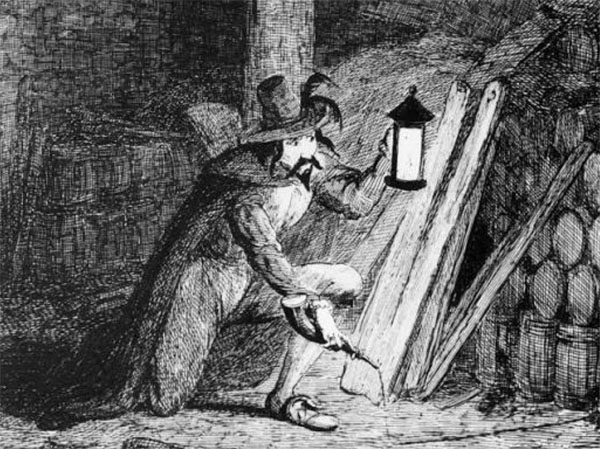
I don’t think there’s a single Englishman alive who hasn’t fantasised about following in the footsteps of Guido Fawkes – said to be the only man to enter parliament with honest intentions.
But if it is easy to countenance, in the abstract, the mass slaughter of faceless MPs, despatching individuals doesn’t have the same appeal. I can’t say that I’ve ever considered murdering an MP, although I would have few regrets if some of them got run down by busses or met with similar untimely ends.
That said, even though the numbers who are actually murdered are low (three this century, including Ann Widdecome, and seven in the 20th Century), their risk of being murdered is much higher than the general population.
Taking just the two sitting MPs murdered in the decade between 2016 and 2026 (Jo Cox and David Amess) out of a constant pool of 650, the average annual murder rate for MPs over that 10-year block is roughly 30.7 deaths per 100,000. Compared with the general UK population of 0.9 per 100,000, this makes MPs 30 times more likely to be murdered than the people they are supposed to represent.
Although some might wonder why the rate isn’t even higher (especially as it was zero for the first 16 years of the century) but, with the murder of Ann Widdecombe – albeit a former MP – members are asking themselves whether it is actually poised to go higher, especially in the light of the number of death threats prominent MPs are receiving.
Picking up on the threat scenario is the Guardian which is running a piece headed: “MPs say death threats a daily reality in ‘increasing climate of abuse’”, with the sub-head telling us: “As Ann Widdecombe’s death raises concerns over security, politicians reveal extent of problem”.
Unfortunately, the paper has picked as its primary example Jess Phillips who in January 2025 – then serving as safeguarding minister – went head-to-head with Elon Musk when she formally rejected a request for the national government to take over and launch a centrally led public inquiry into child sexual exploitation in Oldham.
Phillips argued that the local council and police forces should lead independent local inquiries first, following the precedent set by previous investigations in towns like Rotherham and Telford.
But Musk – aware that the council and police in Oldham were totally compromised – used his social media platform to accuse the minister of perpetrating an intentional cover-up. He posted to his millions of followers that Phillips “deserves to be in prison” and labelled her an “evil witch” and a “rape genocide apologist”.
Unsurprisingly, Musk’s intervention triggered an immense wave of algorithmic-driven hostility against her, famously receiving over 600 rape threats in a single night. Death threats have become a normal part of her life.
Most recently in the frame, though, has been Farage – and more so since police are now investigating whether Widdecombe’s murderer was also targeting other Reform politicians. Currently, he is receiving more than 300 threats a month, with Reform UK recording 1,577 threats against him since February. The nature of these threats is not specified.
It would be wrong though to suggest that Farage is on his own. Threatening MPs seems to be at epidemic level. Trade minister Chris Bryant, for instance, says he has received countless death threats, while in the Commons on Monday Bernard Jenkin said MPs were more likely to meet a violent death than a member of the armed forces or police.
Former victims’ minister Alex Davies-Jones, the Guardian tells us, says threats were a weekly occurrence for most MPs she knew. “It changes how you live your life. You’re constantly on alert and always looking out for danger”, she muses, adding: “I think it’s definitely got more severe. It feels like increasingly some members of the public feel they can openly harass and be quite aggressive”.
This is borne out by an anonymous male MP who said he now avoided pubs after being aggressively cornered while having a drink with his wife. “Someone just launched at me over Gaza, saying that I had taken part in a genocide”, he said. “It’s just not a reasonable discussion, it’s just an attack”.
In response to this litany of woe, and the circumstances of Ann Widdecombe’s murder, The Replacement is on the case, saying politics had “darkened” in the decade he had been away from Westminster. He is now of the view that “a serious review” of MPs’ security is needed.
Asked why he thought frontline politics had become so dangerous, Burnham said: “It’s easy to blame social media, but it feels like it’s having some impact in just building that kind of toxicity that’s around the political debate”.
This is becoming something of a running theme, mirrored by Jess Phillips, who says that the threat to MPs had to be tackled at its source. “Everybody who’s ever attacked me has read a load of untrue stuff online that they had been fed by their algorithm”, she says, thus arguing that “We need to have a very serious conversation about the algorithmic curated content”.
However, she seems to have enough residual self-awareness to acknowledge that “we members of parliament need to take responsibility for our own behaviours and our own rhetoric as well”.
Putting this in context, we hear that The Replacement is set to weaken Mahmood’s proposed changes to ILR eligibility, allowing the1.6 million “Boriswave migrants” to qualify in the current five-year period – a move aimed at placating his own backbenchers who are nervous about the electoral effects of the reforms.
Those same MPs cannot be unaware that there is a huge upwelling of unease about the effects of giving ILR to so many migrants but, as Guy Dampier asks in the Telegraph, “Why should it be more acceptable to disappoint and mislead British voters than to change the rules for foreign nationals?”.
It is this sense that MPs are more concerned to look after their own interests rather than the national interest that is undoubtedly at the heart of much of the hostility towards MPs.
The same goes for the pressing need to reform the welfare system, to remove some of the more egregious abuses. But as long as Labour MPs rely on the client state for their votes, they are going to block even the most modest of changes, despite the impact it is having on taxation and hard-pressed working families.
I am by no means the first or only person to observe that, never in living memory has parliament seemed so distant and detached from ordinary people to the extent that we no longer feel it represents us.
While the likes of Burnham and Phillips finger social media, it is more likely that the MPs themselves are authors of their own grief. Platforms such as X merely reflect the prevailing view about MPs – and serve as a repository of information about how awful they are. The algorithm does not invent hatred – it merely highlights what is already there.
Nevertheless, the MPs are not going to alter their ways. Instead, we are seeing a rash of measures designed to protect MPs but which have the effect of distancing themselves even further from their electorates.
It is said of general elections now that incumbent MPs hate having to go out and canvass for it is then, when they are forced to engage directly with members of the public that they realise how hated they are. If re-elected, they scuttle back to the safety of the Commons, thankful that they won’t have to repeat the experience for another five years.
The likelihood, therefore, is that such measures as will be taken will not be sufficient to protect all MPs from determined assassins, with potentially catastrophic results. As we slide closer to civil war, David Betz directly identifies high-profile targeted killings – specifically political assassinations – as immediate, powerful triggers that accelerate the descent into modern civil conflict.
Although it is increasingly clear that Ann Widecombe’s murder was a political assassination, her distance from the centre seems enough to insulate the deed from broader civil unrest. We will not see riots over Ann’s death.
However, a targeted attempt on the life of a Reform MP – even or especially Farage – could trigger widespread unrest. This would be especially the case if there was tit-for-tat killing, which could never be ruled out, creating a watershed moment where political violence became a normalised tool of ideological warfare.
To avoid this the MP collective, it would seem, needs to find a way of keeping Farage alive – much as they might detest the idea. As it stands, he is marginally more use to them alive than dead, as their safety probably depends on his continued good health. They need to remember that Guido Fawkes was not a fictional character.
