
Politics: status unchanged
By Richard North - July 8, 2026
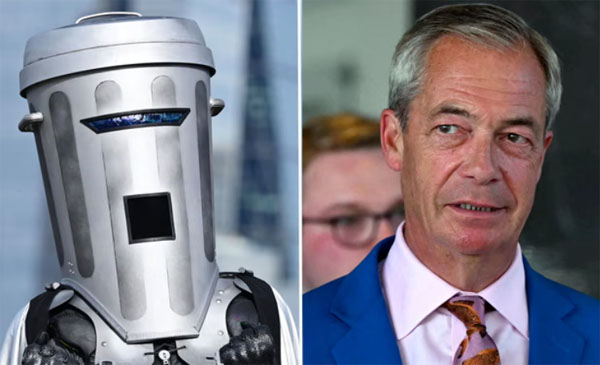
A thought occurs: why, if Farage is so certain that he has done no wrong, doesn’t he let Daniel Greenberg, the parliamentary commissioner for standards, do his job? As it stands, he is frustrating the process by resigning.
Should he be successful in returning to the Commons, one presumes that Greenberg’s investigation – which will have been suspended pro temp – will resume. Then a finding which goes against Farage could have him suspended and yet another by-election called.
It would seem to make sense, therefore, for Farage to have stayed his hand and let events take their course, more so as the other main parties have announced that they will not be contesting the current by-election, making it something of a meaningless gesture.
With no serious competition – unless you consider count Binface to be such – Farage might easily exceed the 46.2 percent vote share he gained at the general. But, in the absence of opposition, one might reasonably expect turnout to fall, delivering a somewhat equivocal result.
Unopposed elections are relatively rare for Westminster seats, but if we use one of the Speaker’s constituency elections – which are traditionally unopposed by the main parties – this could provide a limited guide to what could happen.
The choice here falls on Lindsay Hoyle in his Chorley constituency. As a plain MP standing in the 2017 general election, he gained 30,745 votes, taking 55.3 percent of the vote in a contest which saw a turnout of 72.7 percent.
As Speaker for the second time round in the 2024 election, Hoyle’s share of the vote soared to a record 74.3 percent but, with the turnout plummeting to 45.4 percent, his actual vote count dropped to 25,238, despite the lack of opposition from the main parties.
It is quite possible, therefore, that Farage would walk away from his by-election with a reduced vote count – especially if the ballot is held in August when the turnout might be expected to be lower than normal, even by by-election standards.
From this, it is difficult to see what precisely Farage stands to gain from the election result, although it is quite conceivable that he isn’t looking that far ahead. With parliament going into recess on 16 July for the summer holidays, this – marking the start of the “silly season” period – gives the Reform leader control of the narrative over the summer period when there is usually a dearth of political news.
The BBC’s Chris Mason supports this idea. He notes the situation where Farage could have been forced by the standards process to face his electorate. He is thus “seeking to seize the initiative and bring it on himself”, Mason says.
This, we are told, opens the way for Farage to frame the contest as “the people versus the establishment”, as one friend put it, with friends of the Reform leader adding: “This is Nigel setting the agenda, he is sick to death of being judged by Sky, The Times and Daniel Greenberg”.
With that thesis, the Telegraph seems to agree. It has Nick Gutteridge, its chief political correspondent writing under the headline: “Farage’s gamble is all about seizing control of the narrative”.
But the sub-head shows that tactical acumen which wasn’t immediately apparent from Farage’s dramatic announcement yesterday. This reads: “No Commons seat, no inquiry … and after the Reform leader does return to Parliament, will MPs want to go to the voters of Clacton again?”.
That certainly gives the game away. After one by-election, the MPs on the standards committee, and in the full House, may not want to expose the voters of Clacton to an unprecedented second by-election, not least because they have no means of knowing how the electorate will behave.
What Farage doesn’t seem to have predicted is the response of the other parties. As he announced his decision, Gutteridge writes, he must have expected (at the very least) that Restore Britain would throw the kitchen sink at claiming his scalp in a constituency. After all, it is just along the East Anglian coast from Great Yarmouth, where Rupert Lowe, its leader, is the sitting MP.
In the end, though, Lowe announced that his party would not take part in a “Reform-sponsored media circus” and would instead await any second by-election. Badenough, at the time, was reserving her options but she too has come down on the side of a boycott, along with Labour and the Lib-Dems.
This reduces the contest to what Gutteridge describes in terms of “Farage by-election gamble turns to farce” – the title for his second piece on the issue.
As a gambit, Farage’s assertion that he had “done nothing wrong” and that the people of Clacton should be “the judges of my actions”, had – Gutteridge writes – swiftly backfired as his political rivals refused to stand against him, with opponents calling the resignation a “circus” and a “desperate stunt”.
Farage now faces the prospect of fighting a lone by-election or facing novelty candidates such as Count Binface, which is not entirely the framing he had in mind when he announced that the standards investigation was being used as a political tool against him.
He was at pains to describe the forthcoming contest as “a people versus the establishment by-election”, casting it as “a chance to stick two fingers up at the entire establishment, to frankly tell them where to go”.
This, however, doesn’t quite have the same resonance if, in the absence of opposition, the result is a foregone conclusion, so much so that the media buries the entirely unnecessary campaign and, on the day, the only other candidate on the stage while Farage delivers his victory oration is count Binface.
So far, Farage’s only reward for his gamble is to give Andy Burnham a platform to say: “This is a gimmick designed to distract from serious allegations about Farage’s funders”, while Badenough is holding forth with the statement that: “We will not be standing a candidate in the fake by-election that Farage is causing to distract people from what is happening”.
“We need”, she says, “to let that investigation run its course, and I think the reason why Nigel Farage has resigned is because he’s terrified that he’s going to be found to have done something wrong”.
Needless to say, the legacy media are doing their best to make that happen. The latest “revelation” from the Guardian is that the £5 million gift to Farage by cryptocurrency billionaire Christopher Harborne was reported to the National Crime Agency by bankers who were concerned it may have been laundered money.
Since he has been given the money, the paper says, Farage has given differing explanations over what the money was for and insisted he had no obligation to disclose it because he was not a politician at the time, claiming it had no bearing on his decision to stand in the 2024 general election.
However, the Guardian says that, according to financial industry sources, Farage received at least some of the £5 million after he had announced on 23 May 2024 that he was not going to stand for parliament, saying it was “not the right time for me”. The balance of the £5 million was received shortly before he said he would run for the seat in Clacton.
Although Farage did not notify the parliamentary authorities about the gift, it came to the notice of bankers, who were not satisfied they could trace the ultimate origin of the funds, we are told.
This, in itself is thin stuff. Although the bankers raised their concerns, there is no evidence of wrongdoing. Their official notification was simply an invitation for the NCA to examine the transaction to decide whether there were grounds to investigate it further. It is not the same as a crime report, the paper says.
If that’s the best the Guardian can do, Farage has little to worry him, but it does suggest that there is open season on him – at an intensity that has rarely if ever been matched. For the media, the silly season works in their favour as there is little in the way of real politics to distract them from the hunt.
Yesterday, I recorded Ian Dunt describing Farage as “prey”. And, if yesterday’s announcement was intended to redress the balance, is doesn’t seem to have worked.
As today’s front pages run the Farage story, the Financial Times echoes other papers in saying: “Farage gambit falls flat after rivals refuse to contest ‘fake’ by-election. If Reform’s leader was prey yesterday, today that status is unchanged.
