Politics: badly served
By Richard North - July 5, 2026

Once you start drilling down into the technology of defence equipment, the structure and organisation of fighting units, and the details of the support infrastructure, it all starts getting rather complicated.
You can see, therefore, why the media would want to stick to their comfort zone of the political soap operas and report defence issues within that framework. On the other hand, there is a tendency for the specialist journals to be so supportive of the military that they are relatively uncritical of decisions made, and defensive when critics from outside the specialist circle make their views known.
Readers of the book On the Psychology of Military Incompetence by Norman Dixon, will also know that there are powerful influences which drive authoritarian leaders in hierarchical organisations, perpetuating errors and preventing outside agencies from intervening.
It seems to me, therefore, that with the Defence Investment Plan, we are in one of those situations where we are locked in to a series of strategic errors, the nature of which are beyond the ability of the legacy media to dissect, where the specialists are so compromised that they can offer no useful correctives.
However, bearing in mind that the principal threat is defined as Russia, and we are gearing up to a conflict where – if the naysayers are correct – there is little likelihood of our armed forces actually having to take part in a “hot” war.
Thus, faulty strategic decisions, and the equipment choices that stem from them, are unlikely to be found out. Our military and the politicians can live out their careers into comfortable (state funded) retirement without ever being seriously challenged, and with their errors never exposed by the cold, harsh realities of engagement with a peer enemy.
In a relatively short period, the DIP will disappear into the background, with only sporadic reports in the media – most likely triggered by the occasional reviews by the FAO or the Defence Committee.
By the time concepts such as the CCV come to fruition, their progenitors will be long gone, and it will be for the hapless defence secretary of the day to take the flak, explaining why – as is typically the case – it is late, over-budget and under-performing.
The guilty will never be punished (and mostly not even identified) and no person or group will have stepped in at an early stage with sufficient authority and power to prevent the inevitable and entirely predictable disasters.
Those disasters will be reported on in lurid terms, but nothing fundamental will change. The same cycle will repeat itself, over and over again, as it has done for centuries, entirely impervious to change – as long as we don’t spoil things by actually going to war.
It struck me, therefore, that – in the absence of any serious offerings from the other opposition parties – this was a real opportunity for Farage’s Reform party to fill the gap and come up with an alternative policy which demonstrates that it is a serious political force, fit to take over government at the general election in 2029.
In this mad moment of reflection, however, I momentarily forgot that Farage doesn’t do policy, not in any meaningful way. This is illustrated in the most graphic of ways, by the party’s website, where – in the policy section – the reference to defence comes under the heading: “Rebuild Britain’s Armed Forces”.
The site invites the curious onlooker to “read the full policy”, whence one finds that the party believes in “peace through strength”. Says the policy: “We will rebuild Britain’s armed forces, invest in capability and readiness, end woke, and restore morale across the military and intelligence services”.
It then goes on to promise that: “We will ensure our armed forces are ready to deal with the ever-present threats posed by Russia and China” at which point, the policy comes to an abrupt end. That’s it – that’s all you get.
Apparently, though, not all is lost. At the beginning of last month, the Spectator had Alexander Baker – a senior researcher at the Prosperity Institute happily declare that: “Reform’s ambitious defence offering is worth taking seriously”.
Baker was in fact referring to a speech by Danny Kruger at the Spectator’s National Security Summit the previous week, where he offered “one of the first glimpses of what a national security policy might look like under a Reform UK government”.
The party’s “strategic objective”, the audience was told, would be to make Britain a great power once again, arguing that the state’s job was to “build the architecture” on which British industry and commerce could develop the products and tools that would allow Britain to secure her place among the family of nations.
As to the party’s strategic objective, this would be “underpinned by a doctrine of ‘active deterrence’ replacing the conventional philosophy of deterrence by punishment with a proactive and continuous model of defence and economic competition, one which would likely be more aggressive in the face of foreign intrigue”.
For the time being, however, this word salad will have to suffice. Kruger conceded that the party was still working on fleshing out the policy details, in conjunction with a host of defence, foreign policy, industry experts and intelligence specialists who have recently joined the ranks.
All the audience got was a “partial preview”, where Kruger “singled out the importance of the defence of the homeland and of taking a more proactive approach to dealing with Russia”. This, we were told by Baker, indicated that “increased domestic resilience and a stronger response to the Kremlin’s hybrid interference could become party policy”.
Once again, Baker emphasises that “much of the detail is still to come”, but he thinks that it would be interesting to see the party set out some benchmarks against which they would consider Britain’s status as a great power to have been reaffirmed.
And, with that, we are earnestly informed that “far from being a relative weakness in terms of policy focus, Reform is devoting serious time and resources to developing their defence and security pitch”.
Yet, with Labour’s SDR published last year, and the DIP last week, the debate is already in the here and now and, in terms of detail, Reform has nothing to say.
On the other hand, Pete in his Manifesto Project demonstrates that, even with slender resources and no specialist knowledge, it is possible to set out a rough framework. It may need some more work, but he has managed to deliver more than the “host of defence, foreign policy, industry experts and intelligence specialists” who have recently joined the ranks of Reform.
An intelligent, well-constructed offering could, at this point, put Reform at the heart of the defence debate and provide the corrective which is so necessary to break out of the soap opera media framing and the wishful thinking of the specialists.
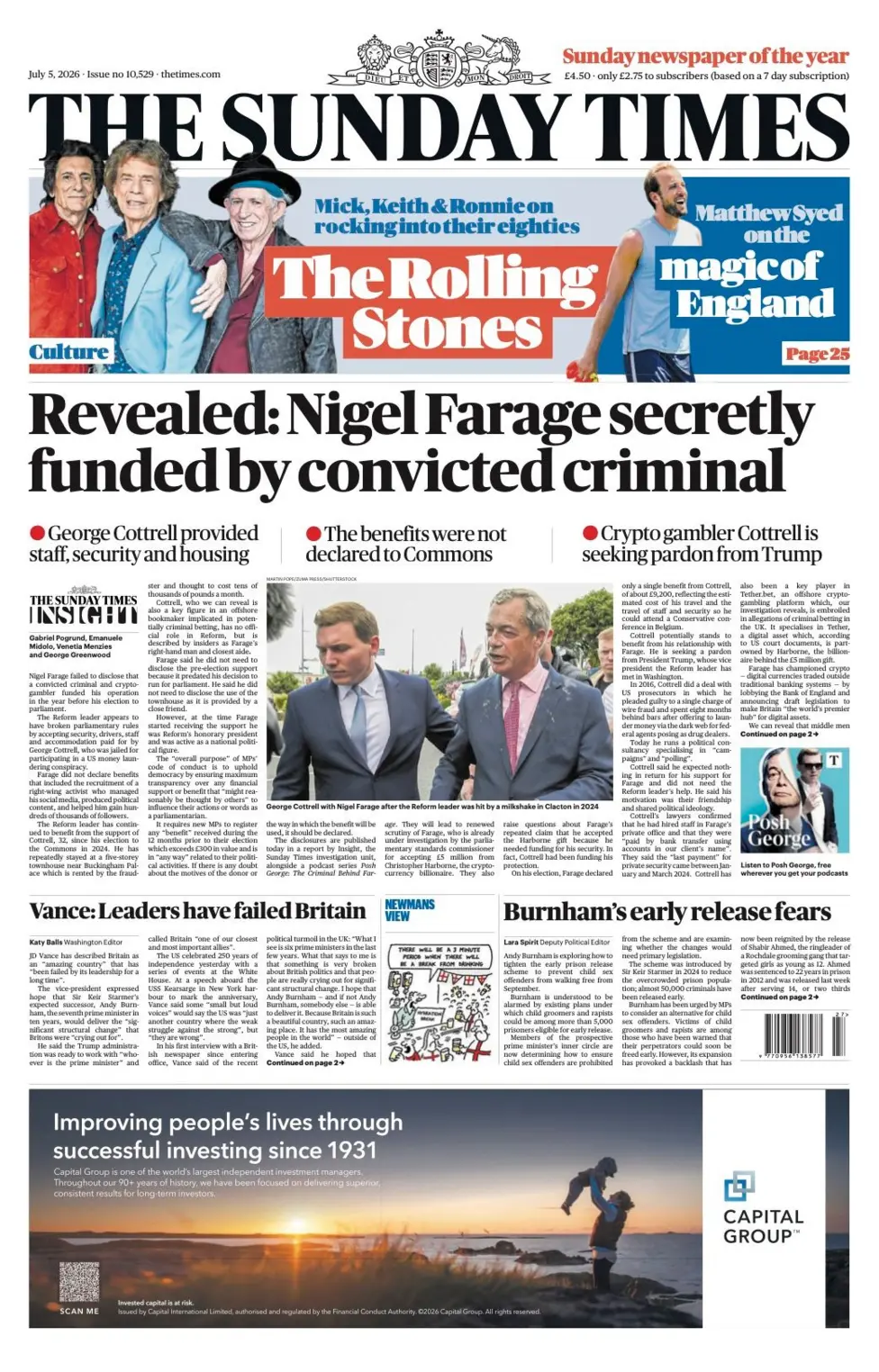
Instead, on the front page of the Sunday Times, we have the lead story headed: “Revealed: Nigel Farage secretly funded by convicted criminal”.
At the end of a very long report, Reform UK is allowed to say: “It comes as no surprise that The Sunday Times has chosen to publish this baseless and contrived story, covering a period of time when Nigel Farage was not even an active politician, let alone an elected one, given that the newspaper backed the Labour Party at the last general election.
Contrary to the story’s tone, the party says, no parliamentary rules have been broken. We also understand The Sunday Times has a new podcast to promote, which it seems very excited about. Its agenda should be plain for all to see”.
This, though, is one of a number of reports which focus on what appear to be the seamier side of Farage’s affairs, not forgetting that £5 million gift, for which he is currently under investigation by the parliamentary authorities.
In my pristine world, Reform would still be on the front pages this weekend, but delivering a coruscating critique of the DIP, putting an alternative agenda on the table and holding a lacklustre Labour government to account, in the dying days of the Starmer regime.
That it is not says a lot about contemporary politics (and the media), but it also points to how badly served we are by Farage’s business enterprise, masquerading as a political party.