
Politics: taken for a ride?
By Richard North - July 26, 2026
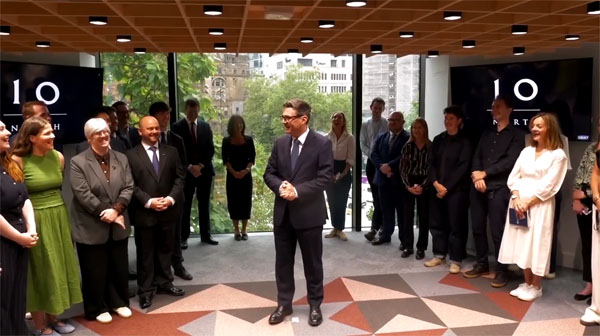
There can be little dispute that social media – and the X platform in particular – is carving out a niche for itself in asking questions that the legacy media isn’t asking or hasn’t got round to asking yet – as well as providing some answers.
In that category currently lies the timeline for the establishment of Mr Burn’em’s ego extravaganza, his home from home in Manchester, located in Heron House and grandly labelled No. 10 North.
I was already framing questions in my own mind and was putting together a piece for today’s post when I happened on this post from Gordon Fielden, a man unknown to me, but one who makes some very good points which bear repeating here, rather than reinventing the wheel.
There are occasions in public life, Fielden writes, when the official explanation may be perfectly true, yet still leave important questions unanswered. The creation of No. 10 North in Manchester appears to be one such occasion.
Within days of Andy Burnham becoming Prime Minister, he reminds us, Heron House had become an operational extension of Downing Street. Ministers were meeting there. Officials were in place. The branding had been unveiled.
Furthermore, as we are all well aware by now, the building was presented not simply as another government office, but as a symbolic new centre of executive government.
The explanation offered is straightforward. Heron House was already a secure government facility, occupied in part by GCHQ and equipped with the communications and security infrastructure necessary to support sensitive government business.
But this then brings us to the point. The rationale for choosing the building does not explain when the decision to transform it into No. 10 North was taken. And, says Fielden, that distinction is important.
Major government projects do not ordinarily emerge fully formed in a matter of days. They require planning. Officials prepare submissions. Departments consider practical implications. Security assessments are undertaken. Budgets are identified. Staff are allocated. Procurement decisions are made. Communications strategies are developed.
Collectively, he argues, these steps leave a documentary record. If that process occurred entirely after Mr Burnham became Prime Minister, then the Civil Service achieved something genuinely remarkable in an exceptionally short period.
If planning began earlier, that is not necessarily improper. Governments and the Civil Service often undertake contingency planning, so they are ready to implement decisions once they are formally approved. The issue, therefore, Fielden asserts, is not whether planning took place. It is when it began, who authorised it, and under what authority it proceeded.
These are straightforward questions of public administration, he says. Among the questions that deserve clear answers are: On what date was Heron House first proposed or selected as the location for No. 10 North? Which department first instructed officials to begin planning the project?
Other questions that arise relate to when GCHQ was first consulted regarding the use of Heron House? When were staffing plans approved? When were branding and communications commissioned? When was the first public expenditure authorised in connection with No. 10 North? Which ministers or senior officials approved the principal decisions?
None of these questions implies wrongdoing. Each seeks to establish a factual chronology. That chronology matters because public confidence is strengthened by transparency.
When government undertakes a significant constitutional and administrative change, the public is entitled to understand how that decision was reached. If the Government’s account is complete, publishing the timeline would remove unnecessary speculation.
If there were earlier stages of planning, publishing the timeline would explain the sequence of events and the basis upon which officials acted. Either way, openness serves the public interest.
Thus, Fielden concludes that the most effective way to resolve this debate is therefore not through political argument, but through documentary evidence. He wants the timelines published – the dates on which key decisions were taken, with details of the departments responsible, together with any ministerial approvals.
The documentary record exists, he says. It should not be difficult to produce. Until it is, the questions will remain – not because they have been invented, but because they have yet to receive a complete answer.
As it happens, remarkably little has been published in the legacy media. The local press tells us that a separate suite of more than 4,700 square feet at Heron House is being used, with the government sub-leasing the space from Manchester City Council.
What we do know now, though – from social media, picked up by AI – is that the lease agreement for the temporary suite at Heron House was approved on 10 June 2026. The public record of this has been posted on the Council website.
The agreement was approved by Manchester City Council. The arrangement is a sub-lease agreement between Manchester City Council (the building owner/landlord) and the UK Government/Cabinet Office (the tenant)
This leads to another commentator asking further questions, such as: why did Manchester City Council approve a lease for that suite on that date?
As he rightly points out, Burnham wasn’t even an MP until the Makerfield by-election on 18th June. He didn’t become Prime Minister until 20th July. So why was the temporary headquarters for “No.10 North” being signed off weeks before he was even elected to Parliament?
This, of course, begs the question as to how a serving Mayor knows he’s about to win a by-election, get parachuted into the leadership, and be crowned PM within weeks. The inference is that the entire sequence was already locked in.
This in turn provokes a further response, where a commentator who identifies as Lady Jane Simkins notes an “even more interesting” fact. As denoted by the reference number 2026/05/11A, the date of the application for the lease was 11 May 2026.
This then leads Ben Graham to comment that, if this is all true, and the Heron lease application really was submitted just three days before Joshua Simons resigned as Makerfield MP.
To him – and it’s hard to disagree – it suggests this whole Andy Burnham Labour coup was being planned months in advance. The building was allegedly already being prepared for Burnham to take over and move the prime minister’s office to Manchester.
One has to bear in mind that, at that point, Andy Burnham was still Mayor of Manchester. Makerfield still had an MP in Joshua Simons, and Labour still had a Prime Minister in Keir Starmer. The whole sequence, Graham says, “feels incredibly murky, with plenty of political backstabbing involved”.
And, as a coda to this timeline, someone else notes that the No. 10 North website (no10north.com) was registered on 29 June, 18 days before Burnham was anointed Labour leader.
As to equipping and furnishing the offices, the Guardian is keen to tell us on 2 July that Burnham’s team were said to be looking for other office space in Manchester.
One source was said to have confided that they had set their sights on Heron House,” a building owned by Manchester city council, and currently occupied by GCHQ”. No hint was given that the lease had already been agreed, and costings are opaque.
From the BBC, embellished by AI, we get Downing Street insisting that the establishment of No. 10 North, (improbably) carries no additional cost to taxpayers. The setup and day-to-day running of the office, it is claimed, are being fully covered under existing Cabinet Office budgets.
We are told that the suite required minimal upfront capital because Heron House was already heavily outfitted as a high-security government facility. A major £13.5 million refurbishment of the building had already been completed by the owner (Manchester City Council) back in 2019 to accommodate its primary tenant, GCHQ.
However, while GCHQ occupies roughly 13,000 square feet of the building, the No. 10 North suite is its own distinct 4,700-square-foot unit located on the second floor. It is sub-leased directly from Manchester City Council.
Although the offices are separate, No. 10 North relies heavily on the building’s existing security infrastructure put in place for GCHQ. But the space functions as an independent political and economic “situation room for growth”, separate from the intelligence services operating elsewhere in the building.
That does leave the timeline questions wide open. There may be innocent explanations but, at the moment, key questions remain unanswered. One cannot help but think, though, that this whole transition from Starmer to Burnham has been “managed” and we are being taken for a ride.
`
