
Politics: wide open
By Richard North - June 14, 2026
There is a singular problem with political punditry, when it comes to predicting the outcomes of by-elections.
Essentially, anyone knowledgeable enough to be assessing the odds, based on the ebb and flow of political discourse, is going to be far more knowledgeable than the average voter in the target constituency. Thus, their reactions will be far from typical, making them prone to misreading the runes.
Something of this is acknowledged in a recent piece in The Times which has journalist Robert Crampton suggesting that: “The real question in Makerfield is who can be bothered to vote”.
The sub-head to his piece reads: “Before the pivotal by-election, voter in the Greater Manchester constituency share their view on Andy Burnham. But how many actually know the poll is on?”.
Given the headline treatment of a by-election that is indeed “pivotal”, such a notion might seem absurd, but Crampton trawls the streets of Makerfield and, of the 20 people he talked to, seven didn’t know that an election was taking place.
Of those that did, there can be no certainty that they will be rushing out to vote on the day. Crampton remarks that, in the last most consequential by-election in Gorton & Denton, also in Greater Manchester, three and a half months ago, when the Greens sensationally won a previously safe Labour seat, the turnout was 47.5 percent.
That, he observes, means that over half of those qualified to vote did not regard the ballot as consequential in the slightest. A majority of those in situ signally failed to feel the hand of history on their shoulder. And from his experience in Makerfield this week, he judges that turnout won’t be much different to the one 20-odd miles east in Gorton.
In fact, in the last election, Makerfield produced a slightly more enthusiastic 52.5 percent turnout but, since by-elections tend to pull in fewer voters, that is probably the best that can be expected – even if Rupert Lowe is claiming that his party is attracting people who do not normally vote.
Low turnouts, of course, change the dynamics of the vote and it is on many occasions that the stay-at-homes decide who wins a particular seat, with the winner often declaring victory by default, on a reduced personal vote.
In this election, the dynamics are doubly difficult to assess because voters are having to make complex calculations on the outcome – those who can be bothered to think about it.
If they are pro-Labour and one of the diminishing band who still support the incumbent prime minister, then their best option is not to vote Labour. The need to vote for the party most likely to beat Andy Burnham, the official Labour candidate.
If, on the other hand, their primary objective to is get rid of Starmer, then they are best voting for Burnham – irrespective of what party they actually do support. Only those who are fundamentally anti-Labour need look at another candidate.
Unlike with other by-elections though, in this contest we seem to have a surfeit of opinion polls. From two days ago, we had the More in Common poll which puts Burnham in the lead with 45 points, ahead of Reform’s Robert Kenyon, who trails on 40 percent.
But, as with other polls, the story here is Restore Britain, which turns in a respectable 8 percent of respondents – not as high as in other polls but enough to deprive Kenyon of the seat.
Then we have a later poll, the results excluding those who say they don’t intend to vote and adjusted by likelihood to vote. This is conducted by Convergent Research and gives Burnham a much healthier lead of 12 points, bringing in 49 percent of the vote as against 37 percent for Reform.
In this poll, Restore draws down a more modest 5 percent, level-pegging with the Greens – not enough to make a difference. Reform loses anyway, giving Burnham a clear shot at the Labour leadership.
Even then, for a brand-new party – with minimal brand recognition at a national level – the polling is remarkably high for Restore. Taking into account Crampton’s observations about the lack of voter engagement, I have a theory on this. Given the similarity between the names, it is possible that people a confusing Reform and Restore, artificially inflating the latter’s vote.
On the actual ballot paper, though, the Reform candidate comes before Restore and the latter’s name is spelt out in full as Restore Britain. With the logos against each, the names are visually different, potentially giving Reform the advantage.
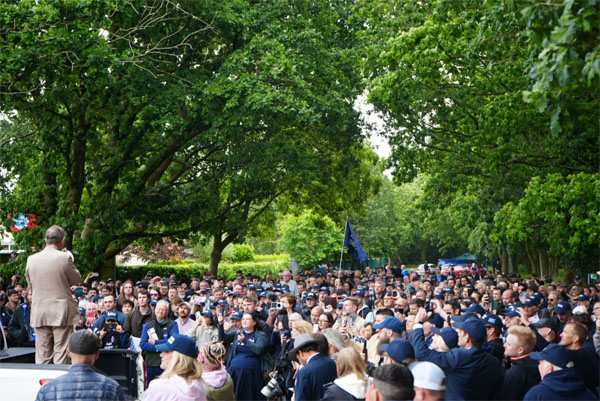
That might have stood though to Thursday but yesterday saw a remarkable event (pictured): maybe a thousand or more Restore supporters descended on the constituency, easily outstripping the combined total of the canvassers for all the other parties. If Restore’s brand recognition started low, it must have taken a significant boost.
Observers on the ground, though, suggest that Lowe’s canvassers were targeting houses of Reform supports, with little overall success. The Reform vote was staying firm. The wider electorate may also be less inclined to go for Lowe’s party if they are aware this it will split the vote and give Burnham the seat.
The Mail on Sunday is making a particular point of saying that Reform can win the by-election if Restore voters switch, also pointing to the presence of Restore’s activists at a “’white supremacy summit” with neo-Nazis in its front page story.
The paper cites evidence that suggests that a vote for “Rupert Lowe’s divisive party” is “a grave mistake”, devoting an editorial to the theme, with the headline: “Anyone who really cares about Britain won’t vote Restore”, warning against voting for “a hopeless party whose members hob-nob with actual fascists and neo-Nazis”.
This is something Pete has been warning about, writing recently of its “emergent neo-Nazi problem that could blow up at any moment” and outlining the stress points in the party.
How this affects the voting will be one of those things we find out when the results from Thursday’s vote come in, but this publicity could not have broken at a worse time for Lowe.
Even then there are other possible confounding factors. It may well be that the Nowak scandal – followed by the Belfast head chopper – steer the vote in the direction of Reform or Restore – although Reform is more likely to be the beneficiary.
On the other hand, the controversy over the Defence Investment Plan and resignation of Healey and others in the ministerial team may play into Burnham’s hands, strengthening the opposition to Starmer and the determination to get rid of him.
Given all the variables – and the inherent inaccuracies in polling at a constituency level – it is probably safest to say that the result is up in the air and could fall any which way.
But, if Burnham does take the seat and the Restore vote has robbed Reform of its victory, there will be ructions on the Right. Already, as one observer puts it, Reform have gone from “Restore are a rounding error” to “Rupert Lowe will be the most hated man in Britain for stopping us winning”. The war will intensify.
In all respects, Farage has only himself to blame for this development, not only in creating an implacable enemy in Rupert Lowe but also in letting the grass grow under his feet in terms of policy development, leaving little clear blue water between the parties.
Farage had best hope that the poll showing for Restore is a chimera and Lowe’s party bombs on the day – more likely now with the intervention of the Mail.
The paper does remark that Farage, to his credit, has “always steered firmly away from any association with the creepy, undemocratic and bigoted types who sometimes try to hang around the fringes of patriotic politics”. It is, the paper says, one of the main reasons for his continuing success.
As long as there remains a possibly that Lowe’s folly in not addressing his party’s Achilles heel has saved the day for Farage, Thursday’s vote remains wide open.
