
Defence: disasters afloat
By Richard North - July 3, 2026
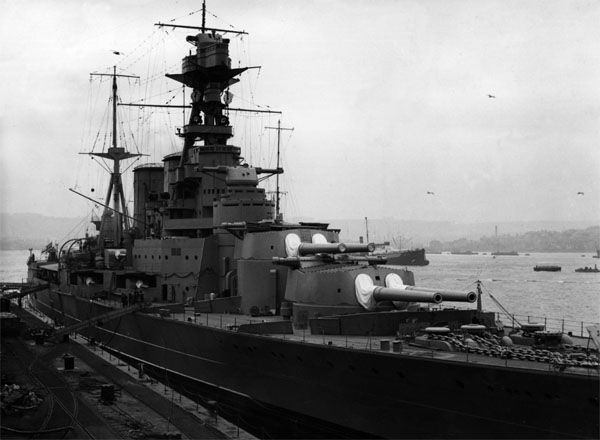
Looking at the train-wreck proposals for the Army in the Defence Investment Plan (DIP), as I was doing yesterday, it is hard to credit that the MoD would have the capacity to make a similar mess for the other services.
However, in respect of the Royal Navy, they seem to have excelled themselves, producing a disaster of equal magnitude, one which also has historic parallels and which mirrors some of the flawed thinking behind the Ajax/Recce-Strike project.
For the historic parallel, we can go back to May 1941 when the pride of the British Empire, the battle cruiser HMS Hood, met its untimely end.
For more than two decades, “The Mighty Hood” as it was nicknamed, had been the undisputed symbol of global British power projection. Even 20 years after her commissioning in 1920, she remained the largest warship in the world, the ultimate “Postcard Ship”.
To a British public and a political class insulated by decades of naval supremacy, her massive silhouette pulling into a foreign port for a diplomatic “flag-waving” tour in 1923-24 was proof enough of an unassailable global status.
Yet, on 24 May 1941, at the Battle of the Denmark Strait, that entire geopolitical illusion shattered in less than ten minutes. When confronted by the raw, uncompromised, and modern firepower of the German battleship Bismarck, Hood’s thin horizontal deck armour was catastrophically exposed.
A single 15-inch shell from the Bismark plunged through her lightly armoured deck into her aft magazine, blowing the ship apart in a catastrophic explosion, sending 1,415 men to the bottom of the Atlantic. Only three crew survived.
The assumptions made when the ship was ordered in 1916 were that the ship’s speed, her eight 15-inch guns and her vertical side armour would protect her against better-armoured battleships, but those assumptions evaporated instantly when the enemy took their real-world vote.
Eighty-five years later, the MoD seems to be preparing to repeat the exact same tragic script in an updated form. As identified in the DIP, the Royal Navy fleet is to undergo a radical restructuring, in which the conventional wisdom for missile-equipped ships has been to optimise on hull mass and magazine depth.
Abandoning the principles of existing warship design, the MoD is opting for an idealised, high-tech concept known as the “Hybrid Navy”, in place of the proposed Type 83 destroyer which was set to replace the troubled Type 45 destroyers.
The replacement is to be a fleet of cheaper, lighter “Common Combat Vessels” (CCVs), which – like the Ajax – are being promoted as the vanguard of a digital revolution – in this case, the seaborne version. Designed to act as a “control hub”, it will command an uncrewed armada of Type 91 missile barges, Type 92 sensor platforms, and Type 93 subsea drones.
In a parallel with the Hood experience, defence planners are trading the modern iteration of protective technology – a capacious missile arsenal coupled with a highly effective early warning system, together with sophisticated damage absorption and containment systems – for the seductive promises of net-centric situational awareness.
The modern MoD is planning to construct another fragile postcard fleet designed for peacetime constabulary duties, leaving it profoundly vulnerable to the attritional reality of modern peer conflict.
As with the Army’s “Recce Strike”, though, the CCV is an old idea dressed in new clothes. It too stems from the failed US theorising of the late 1990s, in the form of the Revolution in Military Affairs (RMA), which spawned the disastrous Future Combat Systems (FCS) and the British FRES.
With the Royal Navy transferring this exact fantasy to the high seas, making the CCV the naval equivalent of Ajax, the deep structural, passive and active magazine defences of the Type 83 – needed to survive a high-intensity warzone – are to be replaced by a lighter, cheaper hull.
In theory, this can safely survive in a peer-contested environment simply by delegating its sensors and weapons to uncrewed drone companions. In so doing, it is putting at risk the ability to conform to the fundamental rule of modern naval warfare based on the concept of “fire effectively first”.
To survive a clash with a technologically equal (peer) adversary, a surface combatant must possess the structural resilience to absorb damage, the electronic warfare capability to disrupt targeting. Crucially, it must also have the magazine capacity to intercept massed incoming salvos while launching an overwhelming counter-strike.
On this metric, the existing surface fleet is already dangerously deficient. The fleet’s primary air-defence platforms, the Type 45 destroyers, carry just 48 Sea Viper (Aster) vertical launch cells.
In a high-intensity engagement against a peer adversary like China or Russia, enemy ships will not launch a single, polite missile for a Type 45 to intercept. They will employ saturation tactics, firing dense, simultaneous salvos of cheap, land-launched anti-ship cruise missiles, ballistic missiles, and low-cost one-way attack drones.
A single massed swarm would completely deplete a Type 45’s entire missile magazine within the opening minutes of a battle. Once those 48 cells are empty, a billion-pound British destroyer becomes nothing more than a defenceless floating target, incapable of rearming at sea and forced to retreat to a secure port – assuming it survives long enough to do so.
Yet, far from being an enhancement, the CCV exacerbates this vulnerability under the guise of “efficiency”. Newly appointed defence secretary Dan Jarvis tells us that the CCV is a way to “expand firepower without a proportional increase in crew or cost”.
The MoD argues that, as a secure command node, the vessel is insulated from danger because its auxiliary uncrewed vessels (the Type 91, 92, and 93 drones) carry the actual radars and missile tubes.
However, this is based on certain assumptions that may not materialise in a real-world conflict, specifically relying on a “clean” electromagnetic environment where satellite uplinks, cloud computing networks, and acoustic underwater data links remain perfectly secure and unjammed.
In that messy real world, a peer enemy will seek to break those digital threads. Through heavy electronic warfare, cyber-attacks, and anti-satellite operations, it will seek to blind the network.
The moment those data links fluctuate, the “hybrid fleet” collapses into isolated components. The uncrewed missile barges will become unresponsive, and the CCV will be left entirely alone, trapped in a lighter, cost-effective hull that lacks the internal magazine volume to defend itself against a saturation strike.
Furthermore, by shrinking the surface fleet down to a handful of hyper-complex, bespoke hulls, the Navy has no margin for error. When in operation, if a new CCV is sunk or severely damaged in combat, the UK loses roughly 10 percent of its entire frontline escort capability in a single afternoon.
Unlike the industrial mobilization of the past, these bespoke platforms take a decade to build and billions to finance; they are completely irreplaceable in the timeframe of a modern war.
And, if one looks at the bigger picture, it gets worse. The justification for the CCV is that it supports three new strategic concepts: Atlantic Bastion, Atlantic Shield, and Atlantic Strike.
These frameworks are designed to project British power into the brutal, unforgiving environment of the High North, countering Russian submarine activity and protecting critical subsea national infrastructure, such as fibre-optic cables and energy pipelines.
Yet, there is a glaring, irreconcilable contradiction between the environment of the North Atlantic and the technical requirements of an uncrewed drone fleet. Maintaining automated data loops, launching fragile autonomous surface vessels, and recovering underwater drones requires relatively pristine, predictable sea states.
The High North, however, is characterized by freezing temperatures, mountainous swells, violent gales, and ice accumulation. When a force is operating in sea state 6 or 7 in the middle of a North Atlantic winter, the delicate, lightweight mechanisms of uncrewed systems fail.
Sensors become encrusted with ice, autonomous launch-and-recovery cradles jam, and small uncrewed surface vessels are easily overwhelmed by the sheer physical violence of the ocean. In these conditions, the MoD’s fantasy of a synchronised drone armada dissolves.
What is actually needed to survive and fight in the High North is raw hull mass, heavy passive structural protection, redundant human crews capable of manual damage control, and deep, physically protected internal missile cells. By prioritizing the CCV over the Type 83, the MoD is purchasing a fleet that is structurally unsuited for the very geographic theatre it is assigned to defend.
Having regard to my earlier piece as well as yesterday’s effort, we see a commonality in the institutional pathology that links 1937 to 2026.
This is the persistent refusal of the MoD to build a force for the war it is likely to face, choosing instead to design a force for the war it can afford to buy, or prefers to fight.
Just as the War Office in the late 1930s locked themselves into a narrow trench-warfare doctrine and fielded the under-armed Matilda I because it fitted tight pre-war budgets, the modern MoD has used the buzzwords of the “transparent battlefield” and “hybrid warfare” to provide faux intellectual cover for a massive structural retreat from raw combat mass, in the interest of cutting costs.
In the real world, this could prove disastrous. A peer enemy will exploit the severe deficit in British magazine depth, flood the battlespace with an overwhelming volume of cheap drones, jam the satellite relays connecting the CCVs to their uncrewed companions, and isolate the fragile surface ships.
Peer adversaries are unfazed by postcard ships and are not impressed by graphic renderings of “hybrid motherships”, doubtless populating PowerPoint presentations being delivered in the Main Building (MoD Whitehall). When or if the balloon goes up (not that we have balloons anymore), the MoD will find that it cannot rewrite the rules of warfare in such a cavalier fashion.
If the UK continues to hollow out its core warfighting hulls in pursuit of unproven digital networks, the pride of the modern Royal Navy will share the exact same fate as HMS Hood – broken in an instant by a reality for which they refused to prepare.
