
Politics: a country in better shape?
By Richard North - July 16, 2026
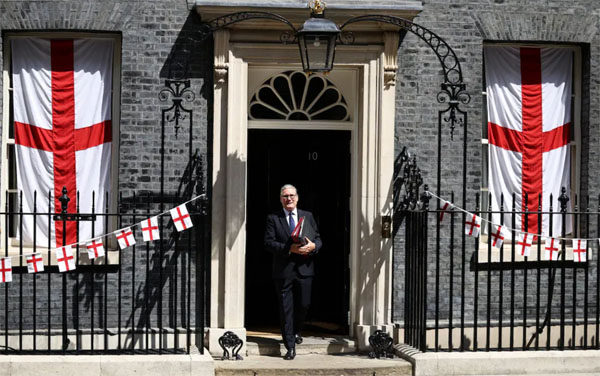
As leader of the opposition heading a party that had just lost the 2019 election – the worst result since 1935, said Keir Starmer at PMQs yesterday, “I turned my party to face the country and Labour won a landslide general election”.
After two years (in office), he went on to say, “we have stabilised the economy. We have invested heavily in our public services. We have put better protections in for children, particularly on child poverty. We have strengthened our defence and we have enhanced our international reputation”. Thus, he concluded, “I am proud to leave this country in a better shape than I found it”.
This he said later, was the “end of my political journey”” and he was proud of everything his government had achieved, at what was his final PMQs before standing down.
It’s not the first time, by any means, that Starmer has made a big deal out of his “landslide” election victory but with the vote carved up multiple ways, he won the election at the end of a dysfunctional Tory regime by not being Corbyn and not being the Tories.
For all that, his party won on the votes of only 20 percent of the registered electorate, gaining his “landslide” only because of the unique fracture of the party system. The victory had very little to do with who Starmer was, and his appeal to voters.
The one-in-five who actually voted Labour carried the day only because the Tories stayed at home or voted for Reform, leaving Starmer’s party to garner 9,708,716 votes compared with the 13,966,454 votes gained by the Tories in 2019 (which dropped to 6,828,925 in 2024).
It is instructive to note that, in the 2019 general election, Corbyn took 10,269,051 votes and lost the election, compared with Starmer in 2024 who actually polled fewer votes but still won – with the Tory vote having more than halved.
That is the measure of Starmer’s “political journey”, a man with 411 MPs as against the Tories’ 121, giving him an overall majority of 172 seats – its third best showing in the history of the party. Despite that huge majority, after two years at the helm, even his own party was sick of him with 379 of the remaining 403 having backed Andy Burnham to replace him.
Not a few pundits remarked on the hypocrisy of his MPs giving him a standing ovation in the Commons (in defiance of convention) when they had only just finished stabbing him in the back.
It was inevitable that Stamer, in striking up his own eulogy, was going to talk up his own performance but, in selecting the “accomplishments” that he did, Badenough, on the opposite benches, let him off far more easily than she should have.
In particular, Starmer’s assertion that: “We have strengthened our defence” and thereby: “we have enhanced our international reputation”, has to be marked down as one of the most outrageous lies that has ever passed the lips of a prime minister.
During his terms, he has presided over final stage cut-backs in the Army bringing the manning level to roughly 73,000, representing its smallest size since 1799, during the early years of the Napoleonic wars – a span of over 230 years.
This is an Army which has more generals than tanks, matched by a Royal Navy which struggled to send a single warship to defend our sovereign base in Cyprus at the start of the US/Israeli conflict with Iran and an air force which could not dominate the skies in any peer conflict without the support of the United States.
Now, with a shambolic Defence Investment Plan (DIP) on the table (one of his last moves as prime minister), we have what amounts to a programme of hidden defence cuts which flies in the face of Starmer’s explicit claim at PMQs that “we have put the biggest investment into defence and security”.
As for stabilising the economy, the best that can be said of Starmer is that the long-predicted economic crisis had yet to arrive on his watch, which means that he got out just in time, leaving The Replacement to take the flack when the impending disaster does overtake us.
And when it comes to him leaving the country in a better shape than he found it, Starmer is stretching the bounds of credulity beyond breaking point. He leaves office with some of the lowest public satisfaction scores for any Prime Minister, dropping to a net approval rating of minus 60.
That is reflected a marked decline in public trust in government, not assisted by a tenure that has been marred by internal cabinet mutinies, rows over the winter fuel allowance, and the high-profile Peter Mandelson ambassadorial scandal.
In terms of feel-good factors, the consumer’s pound in their pocket is wilting under the assault of household inflation. When Starmer entered Downing Street, headline inflation had just dropped to the Bank of England’s two percent target. Today, the rate has risen back up to 2.8 percent, putting continued pressure on the cost of living.
On the other hand, the tax burden under Starmer’s leadership has risen to its highest level in modern British history. Despite Labour’s 2024 election manifesto pledging not to increase major taxes on “working people” (Income Tax, National Insurance, and VAT), the government stripped tens of billions in new revenue by heavily targeting the very people Labour is supposed to care for.
Data from the Organisation for Economic Co-operation and Development (OECD) suggest that taxes on British workers rose at the fastest rate among the world’s richest economies over the last year. The UK’s “tax wedge” – the total tax paid by workers and their employers – saw the sharpest increase among all 38 member nations.
The UK tax burden is officially projected to hit 38.5 percent of GDP by 2030, a post-war high. Economists note that this aggressive upward shift is actively suppressing consumer spending and aggregate economic demand, creating a negative knock-on effect on domestic business investment and job creation.
Yet, despite the desperate need to reduce government expenditure, the burden of economic inactivity and workforce sickness has increased under Starmer’s watch. A record 2.8 million working-age adults are now economically inactive due to health conditions, an escalating crisis costing the state billions in welfare and lost output.
Starmer, in his list of achievements, claims that NHS waiting lists are coming down at the fastest rate for 17 years – although this seems largely due to a studied exercise in manipulating the figures.
On the substantive issues, widespread access issues remain. Extensive Healthwatch tracking indicates that persistent wait times have actively institutionalised a “two-tier system”, driving more people to pay for private healthcare out of pockets.
The NHS still has not got to grips with its A&E crisis, with the service having consistently fallen short of its interim 78 percent operational milestone, let alone its recovery target of 82 percent. More than 1.5 million people have faced waits exceeding four hours over the past 12 months.
Keeping patients on beds or chairs in hallways has become structural. Data show nearly 3,000 people a day end up enduring “corridor care” in clinically unsuitable overspill spaces like hallways and repurposed cupboards.
In a single month, 126,819 patients had waited on a trolley for over four hours after a doctor had decided to admit them. Even worse, 49,466 people faced a brutal 12-hour trolley block before a proper ward bed became free.
Emergency ambulance services are still deteriorating. For Category 1 (Life-threatening) calls, the average dispatch response time sits at 8 minutes and 5 seconds, missing the strict 7-minute national safety target. For Category 2 (Strokes/Heart Attacks), the average response time is 32 minutes and 31 seconds, which is an improvement compared to the worst winter peaks but still far wider than the statutory 18-minute target.
But the problems do not stop with the response times. The primary bottleneck is at the hospital door – 25.6 percent of all ambulance arrivals face a handover delay exceeding 30 minutes because A&E departments are too packed to take patients inside.
And then there is the appalling scandal of NHS maternity services. Recent data indicate a growing clinical safety crisis, with the risk of serious birth injuries rising to its highest level since records began in 2020. Roughly 31 in every 1,000 women are sustaining severe haemorrhages or third-to-fourth-degree tears during childbirth.
With a list that could run into dozens of pages, we also have Starmer’s promise to “stop the boats and smash the gangs” – a central pillar of his regime. The boats have not stopped – approximately 36,000 illegal immigrants arrived via small boats in the full year ending 31 May 2026.
Furthermore, the gangs have not been broken. Rather, they have industrialised their operations to offset risk. Because fewer boats are making it to the beaches, gangs are maximising their profits by cramming unprecedented numbers of people onto single, unseaworthy vessels.
This has culminated in a crossing where a single small boat was intercepted carrying a record-breaking 128 people, while the average number of passengers per dinghy has surged from just 7 people in 2018 to 66 people per boat.
If that amounts to leaving the country in a better shape than when Starmer found it, one shudders to think what it would have been like had it been worse.
The worry of all this is that Starmer probably believes what he is saying. There can be no better illustration of the total detachment from reality of our ruling elite than Starmer’s deluded self-aggrandisement.
Perhaps, though, I should not be so certain of this as that reckons without Ed Davey, who praised Starmer as a “true patriot” when it came to his turn to pay tribute to the departing prime minister at his final PMQs.
There is no dealing with this. Our political class, from its leaders down, are no longer on the same planet. They truly have lost touch with reality, and Starmer is but a symptom of the bigger picture. Soon, he will be replaced by Burnham – but in the Orwellian style of Starmer, things can only continue to get better.
