
Politics: not a serious party
By Richard North - July 10, 2026
One might have thought that the Farage storm would have abated by now, but not a bit of it. Most national newspapers are currently running mixes of news and opinion about Reform UK leader, and the Guardian is giving him the lead story.
Its report is headlined: “Police investigate £500,000 Reform donations from mother of fraudster who backed Farage”, with the sub-head telling us: “George Cottrell’s mother, Fiona, at centre of criminal inquiry over potential evasion of restrictions on donations”.
But this is not just a Guardian thing. The Times (paywall) is also running the story as lead, with a very similar headline: “Police investigate Reform donations by mother of fraudster who bankrolled Farage”, with the sub-head conveying much the same message: “Fiona Cottrell, mother of George Cottrell, who has been funding the Reform UK leaders operations, gave £500,000 to the party before the last general election”.
Even the generally supportive Telegraph is carrying the story, albeit tucked well down its webpage, with the headline: “Police probe £500k donations to Reform by fraudster’s mother”, its sub-head singing to the same hymn sheet, stating: “Fiona Cottrell, 67, gave two £250,000 sums to Nigel Farage’s party in May 2024, weeks before the general election”.
This is not the Electoral Commission or the parliamentary commissioner for standards, but detectives from the Metropolitan Police’s special inquiry team, which actually launched an investigation in February 2025 after a referral by the Electoral Commission.
The detectives are looking at alleged offences under Section 61 of the Political Parties, Elections and Referendums Act 2000, with Mrs Cottrell under suspicion of concealing or disguising the person or entity who is making a political donation. The working assumption is that she has been acting as a front for a non-permissible donor.
It is understood that she is of relatively modest means, and yet has donated a total of £1.75 million to Reform UK and its fundraising vehicle Britain Means Business. The offences – if proven – carry prison sentences or hefty fines.
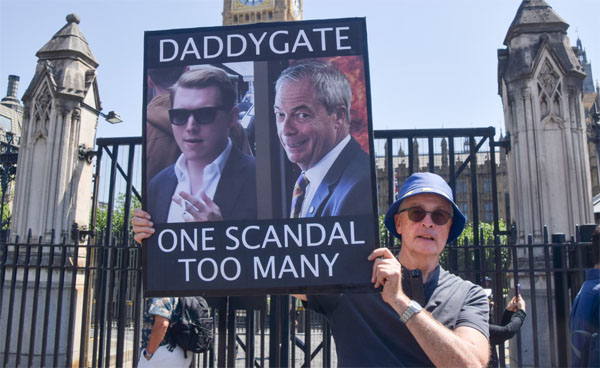
This, doubtless, Farage can do without, especially as it keeps the focus on his relationship with the rather dubious George Cottrell. He is said to refer to Farage a “daddy” and was routinely introduced as his “chief of staff” before the 2024 general election, despite denials that he had any official role.
For all that Reform supporters – along with their leader – are quick to denounce an establishment stitch-up, Farage has a long history of sailing close to the wind on financial matters, and there is a sense here that there is no smoke without fire.
This is reflected in a snap YouGov poll which asks respondents whether they think Farage has been honest about his financial affairs. Against 12 percent who think he has been honest, a massive 60 percent (five times more) mark him down as not being honest, with 29 percent “don’t knows”.
Predictably, he gets majority support from his own party – 40 percent ticking the “honest” box as against 22 percent who think there is something Arthur Daley about his transactions. But here again there is a sizeable “don’t know” quotient, standing at 39 percent – hardly a resounding vote of confidence.
As worrying for Farage is a second part of the polls which asks respondents whether they support his decision to trigger a by-election in Clacton, standing again for re-election.
Only 11 percent strongly support his decision, while a further 13 percent come in the “somewhat supportive”, bringing total support to 24 percent. This compares with the 11 percent who “somewhat oppose” and the substantial 32 percent who “strongly oppose”, topped by 34 percent “don’t knows”.
Once again, this is not exactly a ringing endorsement, lending credence to the view that Farage has misjudged his response to the growing clamour over his and his party’s finances.
To an extent, it is arguable as to whether the response was indeed judged, as opposed to being one of Farage’s knee-jerk actions triggered on the spur of the moment – a behaviour for which he is notorious.
That much is indicated by a piece in the Mail which has Farage conceding that he had been “wrong-footed by the Tories, Labour, Liberal Democrats and Restore Britain as they all refused to participate in the run-off”.
Asked if he had considered the possibility of fighting as the only proper candidate, Farage is cited as “confessing: “No, of course not”. He adds: “Why would they [not contest]? It’s a real election”.
The led to an intervention on X by a sympathetic commentator, Mike Jones, who remarked: “Farage is only human. He can’t be expected to foresee everything. But that’s why he needs a close-knit group of advisers who can plug those informational gaps”.
Jones goes on to say: “How anyone at Millbank failed to foresee the major parties boycotting the by-election is beyond me. The moment I heard Farage’s announcement, my first thought was: they’re going to boycott it. Literally my first thought. I blurted it out loud. It was just so predictable”.
Indeed, it was an obvious move and I came to the same conclusion, leading me to respond to Jones, saying: “The trouble is, Farage doesn’t think so [that he’s human]. He believes in his own BS and is convinced that he can walk on water”.
As to have a group of close-knit advisors around him, I wrote: “he’s been firing his advisors ever since 2003, and will only listen to sycophants who tell him what he wants to hear”. He and they did not game the scenario and they are now left on the back foot, playing catch-up rather than setting the agenda.
The Guardian goes a little further on this (with an ironic photograph – pictured).
According to two Reform officials, the paper says, Farage had been expecting the standards commissioner to report back this week on the £5 million gift issue. A highly critical verdict was anticipated, as was a lengthy Commons suspension.
Since this might have triggered a by-election via the recall petition process, Farage devised the idea of a pre-emptive resignation and re-standing, as a way to seize the initiative.
However, the commissioner then informed Farage that the investigation was being widened to look into allegations in The Sunday Times that he had received other undeclared assistance, this from George Cottrell.
Nevertheless, the die was cast. The decision to call the by-election had been made days in advance, before that development was known – and before the Sky doorstepping, which Farage used publicly as his rationale.
Despite the circumstances changing, Farage decided to press ahead. And there, the Guardian cites an anonymous Reform insider who says it “did not appear to have been entirely well thought through”.
Alister Heath picks up on the developments in the Telegraph, asserting that Reform seems to have given up trying to appeal to the non-populist conservatives it needs to win a majority.
It is, he says, “doubling down on being a protest party, focusing on retaining the grievance and anti-establishment vote, rather than presenting itself as an alternative, professional yet truly radical Right-wing government-in-waiting”.
Never so was that evidenced than from a video clip of an interview between Julia Hartley-Brewer and Laila Cunningham over whether Reform UK was ready for a general election, with JHB dismissing a claim that it was ready, instanced by its lack of a defence policy.
That’s more or less the point I made a few days ago, and it’s something Pete expands upon in his latest Substack.
By any metric you care to imagine, Reform is not a serious party, fit for government (not that that others are), and now the cracks are beginning to show. This by-election charade could thus be the beginning of the end. The real damage – that Farage sought to avoid – is yet to come.
