
Ukraine: the cultural revolution
By Richard North - July 18, 2026
With The Replacement’s confirmation as the new leader of the Labour Party, ready for him to be anointed as prime minister by the king on Monday, we have – in theory at least – three years to chart, analyse and discuss his tenure, which many people expect to be equally as disastrous as that of his predecessor.
With that daunting prospect in mind, I thought I would devote today’s post in the dwindling interregnum to the situation in Ukraine, which I haven’t visited for some time.
Actually, on the battlefield, there is not a great deal to report. Russia is still nibbling at Ukrainian territory, making small gains but at a vastly reduced rate compared with last year, while taking huge losses in manpower and materiel, while Ukraine is expanding the conflict to range deep into Russia to hit energy and other important sites, while isolating Crimea and causing devastating damage to Russian shipping in the Sea of Azov.
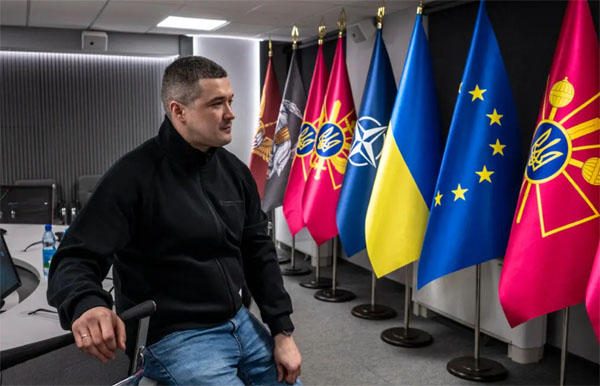
But what is of particular interest at the moment is the removal by Zelensky of his popular defence minister, Mykhailo Fedorov, who has only been six months in the role – a story which has some relevance to our own defence politics.
The 35-year-old Fedorov, was formerly the digital transformation minister where he had acquired a reputation for innovation and anti-corruption effort. He was rewarded with the post of defence minister in January of this year.
During his brief term, he was credited with accelerating drone production and developing further the strategy involving their use, pioneering the introduction of autonomous drones, despite never having served in the military.
He improved procurement transparency, initiated the process of blocking Russian access to Starlink, boosted interception rates of Russian drones and pushed heavily for data-driven reforms.
The proximate cause for his dismissal – dressed up as a resignation – is reported to be a clash between Fedorov’s reformist, technocratic approach and the traditional military establishment, particularly commander-in-chief Oleksandr Syrskyi.
This is borne out by the expected successor, the current interior minister, Ihor Klymenko, who has a close and cordial relationship with Syrskyi. With a law enforcement background, this older man (born October 1972) is something of a traditionalist and viewed as a “stabilising” figure.
This seems particularly important to Zelensky who has had to deal with a turbulent period where Fedorov has pushed aggressive modernisation of the defence portfolio and has accused parts of the General Staff of blocking initiatives, bureaucratic delays, and prioritising “loyalty” over data/effectiveness.
Reportedly, he suggested replacing Syrskyi and chief of the general staff Andrii Hnatov, which has undoubtedly contributed to his ousting, representing a clash between a modernising, free-wheeling innovator and the more centralised, Soviet-influenced command traditions.
Critics of the dismissal argue that Federov’s removal sidelines innovation at a time when drones and asymmetric warfare have been decisive in the conduct of the war against Russia,
Others see Zelensky siding with the military leadership to maintain unity, or preventing Fedorov (a popular, ambitious figure) from becoming a political rival. Others point to entrenched interests resisting procurement reforms that threatened corruption networks.
Zelensky has defended his decision, citing the need for “unity”, while acknowledging that there has been a “challenging dialogue” which has forced him to choose sides.
Fedorov has not taken the dismissal quietly, responding by posting on social media details of his achievements and the shortcoming of the government. This has triggered street demonstrations by his supporters.
This is only the second time since the 2022 invasion that large numbers of people have taken to the streets in anti-government protests, with demonstrators chanting “Stop sabotaging victory”, as veterans and soldiers voice fears of a slowdown of the reform process.
Even some MPs (including from the ruling party), and international observers view Fedorov as one of the most effective wartime officials and his removal risks reversing gains in transparency, drone scaling, and modernisation.
Quite why this is so, and why Fedorov has attracted such widespread support is explained in an analytical piece in the New York Times under the heading: “The 20-Somethings Running Ukraine’s War Machine”.
The sub-head paints the broader picture telling us that: “A new generation has been cutting red tape to speed weapons to the front. But the old guard pushed back, and now Ukraine’s young defense (sic) minister is out”.
The piece starts by underlining the youth and the informal, performance orientated style of Fedorov’s defence ministry officials, many of them in their early 20s, fresh out of university.
Says the NYT, they embody a generational shift sweeping through Ukraine’s defence sector, where young men and women, many of them under 30, are gradually displacing a Soviet-era old guard and establishing themselves as a driving force behind their country’s war effort.
The shift, we are told, runs through every link in Ukraine’s war machine. Twentysomething engineers design sophisticated drones. Young entrepreneurs turn those prototypes into production lines, some using their Western educations to attract foreign funding. At the defence ministry, recent graduates cut red tape to speed weapons to the front.
These same young people took to the streets to protest against Fedorov’s dismissal, a response which is laying bare the generational divide running through the country’s war effort.
In pushing reform of weapons procurement and seeking to wage a tech-driven war, Fedorov has won strong support among young Ukrainians, but at the cost of angering part of the military and defence industry establishment that pressed for his dismissal.
Explains the NYT, the rise of a younger generation has been driven in part by military necessity. Unable to match Russia in manpower and firepower, Ukraine has bet on out-innovating its larger adversary.
That, the paper says, has opened the door to a new generation steeped in start-up culture and new technologies — a change nowhere more evident than in Kyiv’s embrace of drone warfare. It cites Per Holst, the deputy defence attaché at the Danish embassy in Kyiv who says that: “This level of innovation, and the way it’s been integrated into Ukraine’s fight, wouldn’t be possible without these young people”.
Fedorov is credited with accelerating the generational shift. Having first served as Ukraine’s digital transformation minister, he pushed beyond his official portfolio to champion defence entrepreneurs.
His signature creation is Brave1, a government platform that funds defence start-ups and helps turn prototypes into battle-tested products. In three years, it has channelled hundreds of millions of dollars in grants and venture capital to companies, bringing innovative products and systems rapidly into use on the battlefield.
The paper instances Oleksii Antoniuk, deputy head of the defence ministry’s cooperation department who, at the age of 24, has assembled a team of country managers, some younger than he is. What he looks for, he says, is fluency in foreign languages, sharp analytical skills and, above all, a capacity to adapt on the fly. “You have a lot of these qualities in young people”, he states.
But this is more than just an uplifting story. What it underlines is that Ukraine’s technological dominance on the battlefield is not just a matter of applying technical and scientific skills.
Behind these are massive organisational changes, which transform the way things are done, these in turn made possible by fundamental shifts in the culture of the people involved.
The dismissal of Fedorov, therefore, has profound implications for Ukraine, with fears that the state will go back to the way the war was run previously. Fedorov was the symbol of moving forward.
That has massive lessons for the UK. The “lessons” from Ukraine should not be regarded simply as a rag-bag of technological and operational innovation, but as the fruits of massive organisational and cultural changes.
Thus, individual elements of Ukraine’s “revolution” – and that it is – can be copied but that won’t deliver the same effect. The UK, in particular the MoD, the military and the defence industries, must embrace the totality of that revolution. Anything else is just going through the motions.
